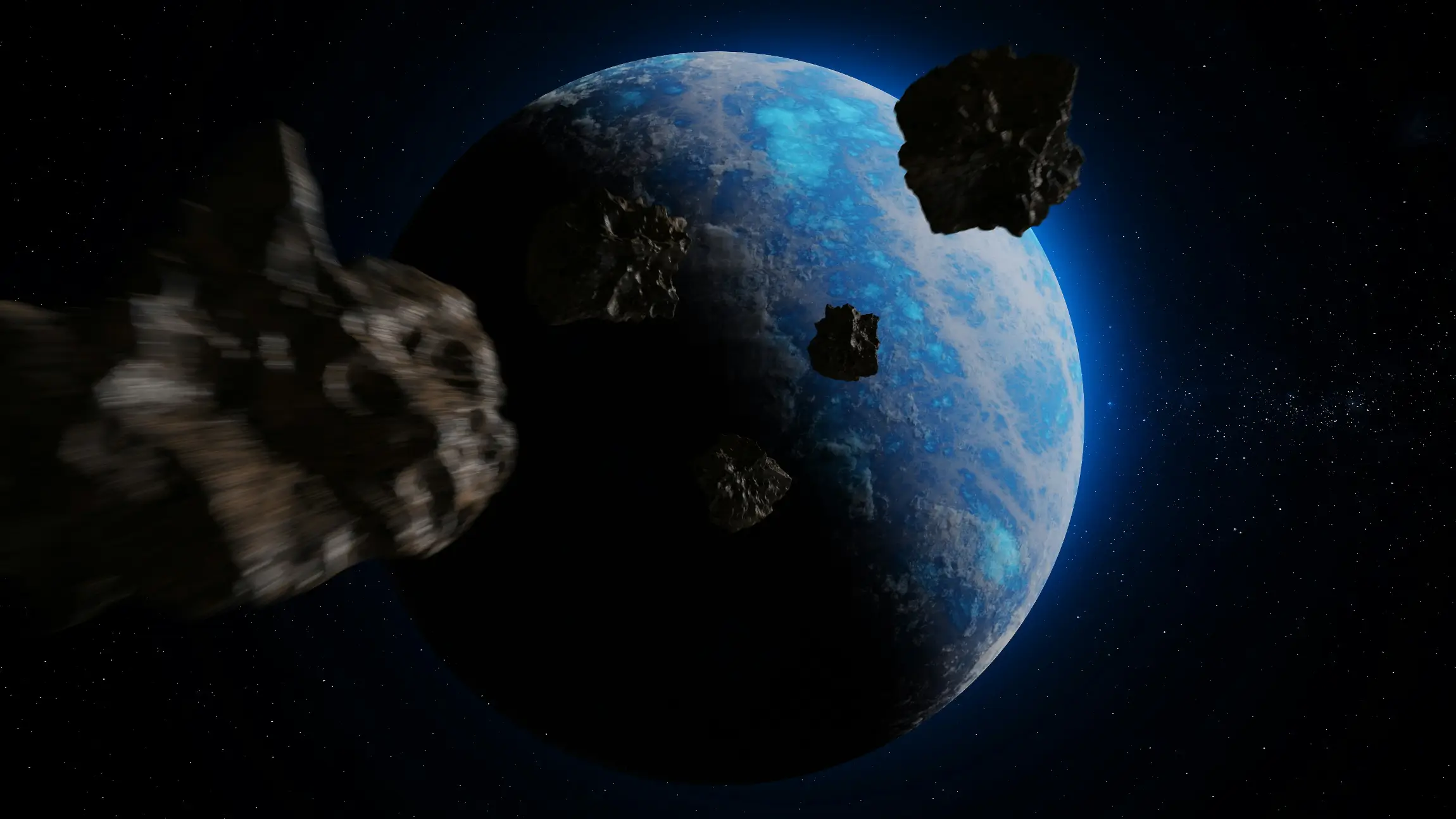
Several asteroids can be seen floating near am blue alian planet

Asteroids Imminent? Maybe Not.

Photo by Javier Miranda on Unsplash

Toggle Switch
Select Reading Level

3 city-killing asteroids could strike Earth within weeks — generating a million times more energy than Hiroshima atomic bomb

A RECENT HEADLINE IN THE MAINSTREAM NEWS

Multiple astroids hitting the earth within weeks and each causing more death and destruction than Hiroshima? Sounds terrifying, right? But is it true? Let’s put this headline through the Trailblazing Science Clickbait Check.

This story, and others like it, appeared across major news outlets. It refers to a scientific paper published in Astronomy & Astrophysics, and claims that at least three asteroids orbiting Venus could hit Earth ‘within weeks’ and without warning. According to the article, these asteroids are capable of wiping out cities and releasing catastrophic energy levels.

An asteroid fills most of the screen. Its surface is bumpy and uneven. IN the disnace is a sun rising above the surface of the Earth

The article also claims that the news gets even worse. It states that our Earth-based observatories will be blind to these asteroids, because Venus blocks our view and the Sun’s glare gets in the way. They say this would leave us with very little time to prepare if an asteroid was on a collision path. They contrast this with the years it would take to make something to intercept a ‘killer space rock’  

All rather alarming, but let’s check the actual science.  

The Science

Let’s go straight to the source: the original study by Carruba et al., currently under review in Astronomy & Astrophysics. The first thing to note is the tone. It’s not dramatic or clickbaity, it’s technical, but also calm, cautious, and grounded in careful modelling.

It’s also important to understand that this study is a pre-print. That means the scientists have submitted it to the journal, but it hasn’t yet been accepted or peer-reviewed. Peer review is how science double-checks itself, other scientists read the paper, question the methods, and confirm whether the conclusions hold up.

Right now, we simply don’t know what the wider scientific community thinks of this work. It might turn out to be solid science or it could have a serious flaw. That’s why it’s always worth checking: has a study been published in a peer-reviewed journal, or is it still a pre-print?

A diagram representing the Fake News freebie. On the left hand side it reads Step 1- Check the Source with a picture of a newspaper and a magnifying glass. ON the right it reads Step 2- look for the original study with a newspaper article with 'Fake news' as the headline standing behind a scientific journal with a red flag next to it.

In fact, Step 2 of the Trailblazing Science “5 Quick Ways to Spot Fake News” is:

Look for the original paper, and be wary of over-hyped articles written based on press releases or pre-prints.

If you want to discover the rest of the steps, grab your free copy below. 

With that in mind, let’s take a closer look at the paper itself.

What did the Scientists actually do?

  • Carruba and colleages modeled how asteroids sharing an orbit with venus might behave, 
  • They ran simulations to see if they could theoretically come close to Earth , 
  • The numerical simulations over a time span of 36,000 years. Looking at hypothetical orbital paths.
  • They tested whether Earth’s telescopes would see the asteroids.

Their findings?

They found the Venus was indeed hiding asteroids that were previously unobserved. They also found that some of these astroids could theoretically come close to Earth and that if they did it would be hard to Earth-based observatories to spot them. What they did not do was make any predictions on how likely they were to come close to Earth or give any sort of timescale for them to do so. 

Venus is beautiful- but it DOES hide asteroids…just not ones that will hit Earth anytime soon,

Spot the Clickbait

A glaring difference between the original article and the newspaper report is the timescales. The original paper makes no mention at all of a likely timeframe of the asteroids to hit or even come close to Earth. Whereas the article states the timeframe of ‘within weeks’ with certainty. 

In fact, the article contradicts itself:

  • It says the risk is “within weeks,”
  • Then admits the scientists modeled 36,000 years of orbital paths,
  • And finally mentions orbital instability could begin in 150 years.

We’d all agree that “within thousands of years” is very different from “within weeks.”

So where does the ‘within weeks’ claim come from?

It’s most likely a misunderstanding, or a deliberate spin, on a completely different point the authors make. The paper notes that Earth-based observatories have visibility gaps when it comes to spotting these asteroids, due to their position relative to the Sun. These observational blind spots can last for a few weeks, but this has nothing to do with the asteroids actually approaching Earth during that time. It’s about when we can’t see them, not when they’re on a collision course.

terrifying, it might not be quite as alarming as it first appears. Two cutting-edge observatories are on the way, and they’re designed to dramatically improve our ability to spot asteroids.

The first is based in Chile and is so finely tuned that it could discover millions of new asteroids within just the first 3 to 6 months of operation. The second is NASA’s planned space-based observatory called the Near-Earth Object (NEO) Surveyor. Unlike Earth-based telescopes, the NEO Surveyor operates outside our atmosphere, giving it a clearer view of space and making it even better at detecting potentially hazardous asteroids.

Sensationalism Red Flags

A fake news checklist. Red flags stand next to the catagories-Fear Bait, Lost in Translation, Big Talk no data, Headline hijinks and Peer-review problems.

This piece is dripping with clickbait language:

  • “City-killer asteroids”
  • “Killer space rock”
  • “Wreaking havoc”
  • “The researchers warned…”

This is generally a red flag designed more to sensationalise than impart genuine science. 

The headline is designed to induce fear in the reader to encourage them to click on the article. To do this, it grossly misinterprets and exaggerates the science. 

These are classic fear-bait tactics: language designed to grab clicks, not deliver facts.

Clickbait Score: 85%

A Test tube with the words 'clickbait concentration written above it. And '85%' written below it. On the side are the measurement marks- low, moderate, high and full bait Mode. A red liquid fills to the 85% mark. The rest is a blue liquid. It represents an approximation of how much of the article was fake news vs accurate science


This headline exaggerates timing, ignores nuance, and plays on fear. The study is real, but misrepresented.

This isn’t cool science. It’s classic clickbait.

Curious but cautious?

Love diving into science but not always sure what to believe? Grab our free guide:
“5 Ways to Spot Fake Science News”
It’s full of quick, practical tips to help you tell real breakthroughs from misleading headlines.

It’s not always easy to know which science stories to trust, but we’ve got you covered. Sign up for our newsletter to get reliable, easy-to-understand science updates sent straight to your inbox.

Want to Read REAL Space Science?

If you love space but want the actual facts (without the drama), check out our latest incredible space science blogs below

Self-healing moon bricks made from bacteria!

How NASA is solving the space farming puzzle

Smart Fabrics Transforming Healthcare, Space, and Robotics: 10 incredible inventions.

Related Posts

Leave a Reply

Your email address will not be published. Required fields are marked *