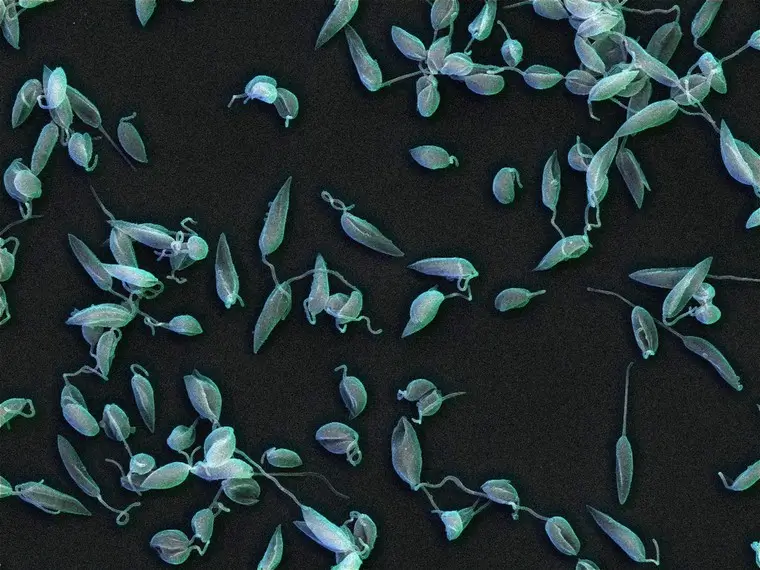
A microscopic image of Leishmania mexicana parasites in the promastigote stage. We can see dozens of them. Their pale blue bodies are visible against a black background.

Zooming in on Cutaneous Leishmaniasis: The Hidden Scars of a Neglected Disease

Image: Leishmania mexicana parasites in the promastigote stage, SEM. University of Oxford, Richard Wheeler. Source: Wellcome Collection.

Toggle Switch
Select Reading Level

You might not have heard of it, but Cutaneous Leishmaniasis (CL) is far from rare. Caused by a tiny parasite carried by sand flies, it leaves slow-healing wounds that can develop into lasting scars. The World Health Organisation estimates there are between 600,000 and 1 million new cases of Leishmaniasis every year, mostly in regions with limited access to healthcare and prevention.

To those who’ve never seen it, CL might sound like just another tropical disease. But for those affected, the physical wound is only the beginning.

Just ask Jessica Robbins.

When Jessica Robbins posted her selfie on LinkedIn, she wasn’t seeking likes, but seizing the power that had been taken from her. She had recently battled through misdiagnoses, dismissals from experts, ridicule and insensitivity. This had inevitably taken a toll on her mental health.

Jessica's selfie. We can see the lesion on her nose.

Image courtesy of Jessica Robbins

One year earlier, while working in Mexico, she had unknowingly been bitten by an infected sandfly. What began as a tiny red spot on her nose turned into a life-altering lesion. The diagnosis was missed for months. By the time she found answers, the damage to her skin and confidence was done.

Jessica’s story reveals the emotional and social burden behind the science. The scars it leaves can cost far more than lost workdays; they carry the weight of stigma, isolation, and mental health struggles that last a lifetime.
But to truly understand this disease, we need to zoom down. From the person, to the insect, to the invisible world within a single cell.

Meet the Sand Fly 

A sandly bites a person and takes a blood meal

A sand fly biting human skin. Content provider: CDC/ Frank Collins, Public domain, via Wikimedia Commons

Sand flies are tiny biting insects that thrive in warm, humid environments. They are widespread in some parts of South America, Africa and Asia. Unlike mosquitoes, they are silent fliers, which, coupled with their size, makes them hard to notice. Only female sand flies bite, as they need a blood meal to produce eggs. But to understand why this bite is a problem, we need to zoom down once again… to something so small, dozens of them could stand on the end of a single human hair. 

Meet the Parasite 

A microscopic image of Leishmania mexicana parasites. One parasite is shown. We can see a long thin body which has been artificially coloured to make it visible.

 Leishmania mexicana parasite in the promastigote stage, SEM.University of Oxford, Richard Wheeler. Source: Wellcome Collection.

Inside some female sand flies live a microscopic hitchhiker, a parasite called Leishmania. When an infected sandfly takes a blood meal, it can pass the parasite into a person’s skin.
There, specialised immune cells called macrophages quickly engulf the intruder, a normal defensive move to destroy anything foreign. But Leishmania has evolved a clever trick: it shuts down the macrophage’s killing machinery, turning the cell into a safe hiding place instead.
Protected inside its host cell, the parasite quietly multiplies, hidden from the rest of the immune system, a stealth strategy that makes the infection so persistent.

There are over 20 species of Leishmania that can infect humans, and the type determines how severe the disease is and how it spreads in the body. 

 A micropscopic image  of a large round macrophage stained light purple. It is jam packed with parasites, shown in dark purple.

A macrophage (the large light purple circle) is chock full of Leishmania parasites (the smaller dark purple splodges) Stefan Walkowski, CC BY-SA 4.0 https://creativecommons.org/licenses/by-sa/4.0, via Wikimedia Commons

Treatment Options 

There are several medications available for CL, but not every treatment suits every patient. The right choice depends on the specific subtype of CL and on individual health factors. This can pose real challenges for patients living outside endemic regions, where access to testing and expertise is limited. Jessica, for example, struggled to have her samples analysed to determine which drug would be most effective. Again and again, she was told that CL simply “wasn’t a priority” in the United States. And even when the correct treatment is available, the side effects can sometimes be severe.

Many incredible scientists and experts are working hard across the world to find new treatments and improve the lives of those with CL. 

For example, scientists have started to wonder if nanoparticles could be one way to treat CL. 

REALLY Tiny Particles

Nanoparticles are tiny beads…so tiny in fact they are thousands of times smaller than the Leishmania parasite…yes we are shrinking down again!

A microscopic iamge of the nanoparticles. Thez are coloured various shades of blue and purple. various siye of nanoparticles can be seen looking like colourful beads

Nanoparticles for drug delivery. Annie Cavanagh. Source: Wellcome Collection.

Because of their tiny size, once they are in the body, they are rapidly engulfed by specialist cells of our immune system, exquisitely designed to engulf and internalise foreign particles. The same cells where the leishmania parasite hides!

Scientists have tried making these nanoparticles out of many different materials, but one exciting approach has been to use iron oxide nanoparticles. These are pretty stable and harmless within our bodies. But once they are inside the special machinery contained within a macrophage, a chemical reaction starts to occur that produces something called Reactive Oxygen Species or ROS. These go on to cause so much damage to the parasite that it dies.

Not only this, but they seem to offer a ‘boost’ to the macrophage itself- allowing it to once again ‘see’ and attack the parasite. Healthy human cells are safe from the destructive force of the ROS, as the macrophage acts as a kind of bubble, keeping all the action within itself. 

This is just one of many exciting advances in the fight against CL.
Yet despite these efforts, CL remains a neglected disease. There is still too little attention and funding to tackle it as effectively as we could. Because it’s not usually fatal, the devastation it causes is often underestimated. When the “cost” of CL is measured, the focus tends to fall on lost workdays and productivity, not on the deep mental and social burdens people live with every day.

To learn more about why some diseases are neglected, check out this blog next

Zooming Back Out: The Bigger Picture

We often imagine a disease as “over” once it’s treated, but that idea hides the true cost of CL. Even after successful treatment, studies show it leaves behind a heavy financial burden and deep social scars that can affect mental health and livelihoods for years.
In many regions, people face lifelong stigma because of the visible marks the disease leaves on their skin. These scars can affect relationships, employment opportunities, and community acceptance, turning a medical problem into a social injustice.

Changing Climate, Changing Risks

As the planet warms, so does the reach of the sand fly. Shifts in temperature, rainfall, and land use are creating new habitats where these insects can thrive. Areas once too cool or dry are becoming suitable for their survival.
Already, scientists have detected Leishmania-carrying sandflies moving northward into southern Europe and parts of North America.
For global health experts, this raises urgent questions: are healthcare systems in these regions prepared to recognise a disease they’ve rarely seen? And what happens when diseases once dismissed as “tropical” are no longer contained to the tropics?
Climate change is not just an environmental issue; it’s a public health one, redrawing the map of neglected diseases like CL.

Despite its impact, CL remains a neglected tropical disease, meaning it receives little attention or funding compared to illnesses that affect wealthier countries. Organisations like the WHO have highlighted the urgent unmet need for better treatments, diagnostics, and prevention strategies, particularly in areas affected by poverty and conflict.

And what would Jessica want people to know? That CL is not directly contagious, there’s no need to keep your distance, and that just because a disease isn’t life-ending doesn’t mean it isn’t life-altering.
Her story, like so many others, reminds us that those living through a CL diagnosis deserve a fairer, more supportive world.

CL is more than a medical challenge. It’s a question of justice, visibility, and global responsibility.

From the microscopic scale of a parasite to the vast scale of global health, CL asks us to look closer. And to care more.

Here’s some ideas to spark a fascinating discussion.

  • If CL mostly affected people in wealthier countries, do you think there would already be an effective vaccine?
  • As climate change spreads tropical diseases northwards, will that finally make the world take them seriously, and what does that say about us?
  • Should countries that have historically emitted the most greenhouse gases help pay for the healthcare impacts of diseases that are spreading because of warming?
  • Why do some scars, like those from accidents, attract sympathy, while others from disease attract judgment or disgust?

Big Family Question:

Would you post about your own illness or scars online to raise awareness, or would that feel too personal?

Looking for more family-friendly discussion prompts? Explore our child-focused version of this blog.

Curious but cautious?


Love learning about groundbreaking research but not always sure what’s real and what’s hype?
Download our free guide: “5 Ways to Spot Fake Science News.”
It’s full of quick, practical tips to help you tell genuine breakthroughs from overblown claims.

Diseases like cutaneous leishmaniasis remind us how complex global health science can be, from climate change to neglected diseases and new nanotech treatments.
Stay curious and stay informed as we uncover the evidence behind the headlines, and the human stories behind the science.

Keep Exploring

Want to keep uncovering how science is reshaping our world?
Explore more Trailblazing Science stories that reveal how discoveries, from tiny parasites to powerful new technologies, are changing how we live, travel, and stay healthy.
Stay curious, stay questioning, and see where the evidence takes you.

When the World Looks Away: The Hidden Story of Neglected Diseases

Neglected No More: Transforming African Sleeping Sickness Care

Microrobots Fighting Lung Disease. 

Join the Conversation


CL is caused by one of the tiniest parasites on Earth, yet its impact is shaped by some of the biggest issues in global health: inequality, climate change, and awareness.
What do you think:

  • Why do you think some diseases get called “neglected”?
  • How could science, or society, help change that?
    Share your thoughts or experiences below. I’d love to hear your perspective.

Related Posts

Leave a Reply

Your email address will not be published. Required fields are marked *