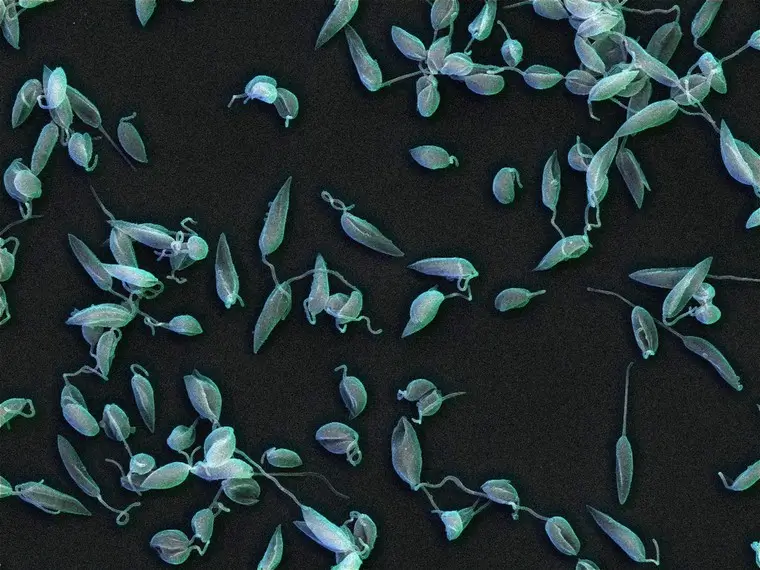
A microscopic image of Leishmania mexicana parasites in the promastigote stage. We can see dozens of them. Their pale blue bodies are visible against a black background.

Shrinking Down to See a Hidden World: The Story of CL

Image: Leishmania mexicana parasites in the promastigote stage, SEM. University of Oxford, Richard Wheeler. Source: Wellcome Collection.

Toggle Switch
Select Reading Level

You might not have heard of it before, but there’s a disease called Cutaneous Leishmaniasis, or CL for short. It’s caused by a teeny-tiny parasite that lives inside sand flies (yes, those little buzzing insects!). When an infected sand fly bites someone, it can leave behind a nasty sore that takes a long time to heal and sometimes leaves a scar.

Every year, up to a million people around the world get Leishmaniasis. It mostly happens in places where it’s hot and where doctors and medicine can be harder to find.

To people who’ve never seen it, CL might sound like just another tropical illness. But for those who have it, the sore on the skin is only the start of the story. Let’s hear from someone who has lived through CL. 

Meet Jessica

When Jessica noticed a small spot on her nose, she didn’t think much of it at first. But soon it started to grow, and she began to worry. She went to lots of doctors before anyone realised what was really going on, she had CL. A tiny sand fly had bitten her while she was in Mexico, though she hadn’t even noticed it at the time.

Her first challenge was just finding out what was wrong. But that turned out to be only the beginning. Getting the right treatment was hard too. And every day, she had to deal with unkind comments from people who didn’t understand. Some were scared they might catch it (they couldn’t!), while others made fun of how her face looked.

One day, Jessica did something incredibly brave. She posted a photo of her face online. It was her way of saying, “I’m not hiding anymore.”  She refused to let the bullies, or the disease, win.

Jessica's selfie. We can see the lesion on her nose.

Jessica’s story shows that CL can have a much bigger impact than it first seems. Looking different can make people feel lonely or left out. It can change how others treat them, how confident they feel, and even what jobs they can do.

But if we really want to understand how a single sand fly bite can cause all this, we’ll need to shrink ourselves down. Ready? We’re about to become the size of a sesame seed,  small enough to explore the life of a sand fly!

Meet the Sand Fly

Now that we’ve shrunk, the sand fly in front of us is the same size as we are! Suddenly, she doesn’t seem so tiny anymore. She’s flying quietly through the warm air, searching for a tasty drop of human blood.

A sandly bites a person and takes a blood meal

A sand fly bites someones arm. Content provider: CDC/ Frank Collins, Public domain, via Wikimedia Commons

Sand flies are sneaky biters, they’re so small and fly so silently (unlike those noisy mosquitoes or buzzing house flies) that you might not notice them until it’s too late. Sometimes, you don’t even feel the bite at all!

We can tell our sand fly is a female because only the girls bite. They need a blood meal to help make their eggs.

Have you ever been bitten by a sand fly? Their bites can leave a small, itchy red spot, annoying, but usually harmless. However, sometimes the bite can pass on something far more serious.

To understand how, we’ll have to shrink down again, this time to the size of a parasite, a tiny germ that can make us sick. We’re about to get really small, so small that twenty of us could stand side by side on a single human hair!

Meet the parasite. 

Now we’re so tiny that we can actually travel inside our sand fly! As we look around, we spot her secret passenger, a parasite, or tiny bug, called Leishmania.

A microscopic image of Leishmania mexicana parasites. One parasite is shown. We can see a long thin body which has been artificially coloured to make it visible.

A Leishmania parasite under the microscope.University of Oxford, Richard Wheeler. Source: Wellcome Collection.

Our sand fly is flying close to someone’s ankle now… wait for it… whoosh! Just as she bites and starts to suck blood, the parasite shoots into the person’s skin. Quick,  let’s follow it!

Inside the skin, we see a big blobby cell rushing toward the parasite. Before long, gulp! It’s swallowed the parasite whole! This cell is called a macrophage, and it’s part of the body’s defence system. Macrophages are like tiny vacuum cleaners: they gobble up anything that shouldn’t be there,  dirt, germs, or invaders,  and destroy them. They also send signals to the rest of the immune system to help fight off the attack.

So, phew! That should take care of the pesky parasite… right?

But wait… what’s happening? The macrophage isn’t destroying it at all! The Leishmania parasite has cleverly switched off the macrophage’s killing powers. Instead of being destroyed, it’s moving in,  turning the cell into its cosy new home. From here, it can hide from the rest of the body’s defences and quietly make more copies of itself.

A micropscopic image of a large round macrophage stained light purple. It is jam packed with parasites, shown in dark purple.

A macrophage (the large light purple circle) is chock full of Leishmania parasites (the smaller dark purple splodges) Stefan Walkowski, CC BY-SA 4.0 https://creativecommons.org/licenses/by-sa/4.0, via Wikimedia Commons

That’s bad news. When this happens, the infection keeps growing, and the sore on the skin doesn’t heal without treatment.

And here’s something else: there’s not just one kind of Leishmania, there are many types. Each one affects people in slightly different ways, but they all have one tricky thing in common- they’re very hard to get rid of without proper medicine.

Treatment options

Because there are so many different kinds of this parasite, doctors have to make sure each person gets the right treatment for their type of disease. But that’s not always easy. Some places don’t have the special tests needed to find out which type it is.

And even when the right medicine is found, it can sometimes make people feel quite unwell while it’s working. So scientists around the world are searching for ways to make treatment safer, faster, and easier for everyone who needs it.

Let’s take a closer look at one clever idea they’ve been testing. 

Really Tiny Beads

Ready to shrink again? This time we’re going thousands of times smaller than even our parasite. Now we’re so tiny that even super-powerful microscopes would struggle to spot us!

We’ve landed in a scientist’s lab, where something amazing is happening. All around us we can see lots of balls, each about the same size as we are now. The scientist is testing whether these balls could help fight CL.

A microscopic iamge of the nanoparticles. Thez are coloured various shades of blue and purple. various siye of nanoparticles can be seen looking like colourful beads

Nanoparticles Annie Cavanagh. Source: Wellcome Collection.

Because they’re so small, when they go inside the body, they get gobbled up by the same type of cells we saw earlier, the macrophages! But this time, the macrophages are getting a little help. These special balls are made from a material called iron oxide. It’s safe for people, but once it’s inside the macrophages, it starts a process that harms the parasite and helps kill it. Even better, it helps the rest of the body’s defences spot the parasite again, so the immune system can attack it from all sides. Pretty clever, huh?

Our scientist is working hard. But if we truly want to beat CL we need many more people like him. We need more scientists, more awareness, and more support. Sadly, not many people know about CL, and there isn’t enough money to find new treatments. That’s why it’s called a neglected disease. To learn about just why some diseases are neglected check out this blog next.

Want to find out why some diseases get left behind and what we can do about it? Check out this blog next. 

Zooming back out


Right, that’s enough of being tiny! Let’s grow back to our normal size so we can take a look at what’s happening with CL around the world.

Our planet is getting hotter and we all know that’s a big problem. But did you know it can also change where diseases spread? Places that used to be too cool or dry for sand flies are now becoming perfect homes for them. That means sand flies (and the pesky parasites they carry) are moving into new areas. So people can now get CL in countries where it never used to be a problem.

If you need a refresher about what climate change is, check out the video below:

Even though CL can have a big impact, it’s still called a “neglected tropical disease.” That means it doesn’t get as much attention or money for research as illnesses that happen in richer countries. We urgently need better treatments, ways to spot the disease, and ways to prevent it, especially in places where people don’t have easy access to doctors or medicine.

Stories like Jessica’s remind us how powerful kindness and understanding can be and how even small actions can make a big difference. CL might start with a tiny parasite, but it can make a big difference in someone’s life.

From the tiny parasite hiding in a sand fly to the big, wide world we all share, CL reminds us to look closely, care deeply, and help where we can.

Here’s some ideas to spark a fascinating discussion.

  • Why do you think some diseases get more attention or money than others? Is that fair?
  • How do you think warmer weather could change where insects like sand flies live? Can you think of other animals that might move because of climate change?
  • Jessica shared her photo to help others understand CL. How do you think that made her feel? What can we do when someone looks different because they’re sick?
  • The parasite and nanoparticles are both tiny, but they can cause or cure huge problems. What other small things make a big difference in our world?

Big Family Question:

What can we do, even if we’re not scientists, to help make sure people with rare or neglected diseases aren’t forgotten?

Curious but Cautious?

Love science stories but sometimes wonder what’s real and what’s just hype?
Download our free family guide: “Is It Real or Rubbish? A Science News Checklist for Curious Families.”
It’s packed with simple ways to check whether a science story really adds up, so you can explore amazing discoveries with confidence and curiosity.

Want to Keep Exploring?

Want to keep uncovering how science is changing our world, from tiny parasites to giant rockets?
Dive into more Trailblazing Science adventures that reveal how discoveries are shaping our health, our planet, and even our future in space!

The Hidden Illnesses You’ve Never Heard Of

From Fly Bite to Recovery: A Story About African Sleeping Sickness

How Do You Water a Plant in Space?

Join the Conversation

Jessica’s story shows how something as small as a sand fly can have a big impact on someone’s life.
What do you think:

  • How would you feel if you looked different because of an illness or injury?
  • What could schools or communities do to help people feel supported and included?

We would love to hear your thoughts- leave us a comment below!

Related Posts

Leave a Reply

Your email address will not be published. Required fields are marked *