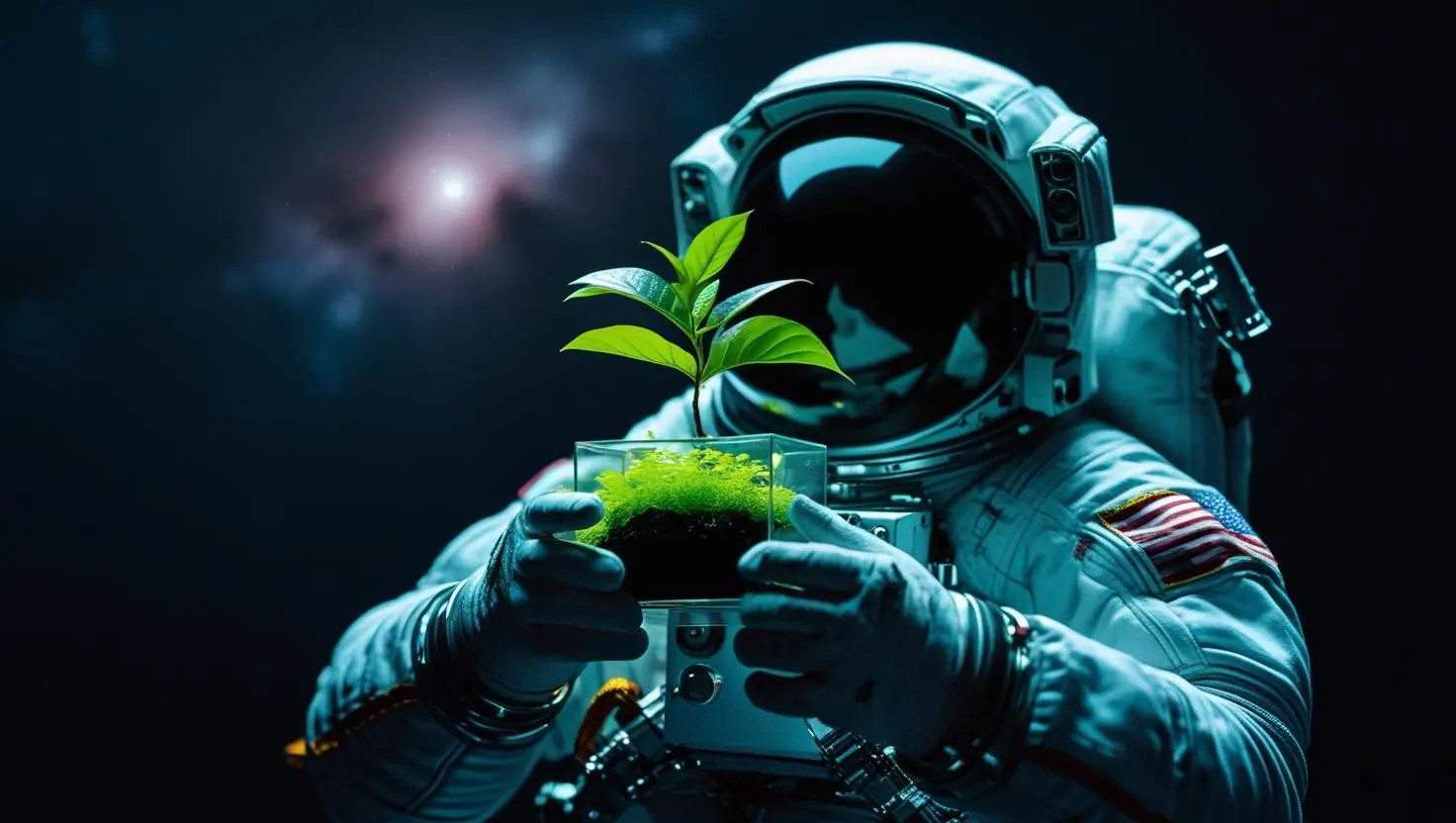
An astronaut in a spacesuit holds a small green plant
|

How NASA Is Solving the Space Farming Puzzle

Toggle Switch
Select Reading Level

How do you water a plant where there’s no up, no down, and no gravity to help you? Imagine an astronaut tipping a watering can, only for the water to float inside as a weightless blob, refusing to pour. In microgravity, even the simplest task becomes a physics challenge. That’s why NASA is investing in advanced experiments aboard the International Space Station to answer one surprisingly complex question: how do you reliably water plants in space?

NASA’s latest experiments- PWM-5 and PWM-6 (short for Plant Water Management)- are a major step toward solving this. Recently launched on the Innternational Space station,  these systems use advanced geometry, fluid dynamics, smart materials, and 3D-printed tech to make water behave as if gravity still exists.

And this isn’t just about space gardens. Mastering how fluids move in microgravity could revolutionise air conditioning, waste recycling, and fuel systems on future space missions. Back on Earth, it could lead to low-energy irrigation systems for use in deserts or vertical farms.

Read on to discover just how they are getting to the root of the problem. 

Why do we even want to grow plants in space? 

As humanity plans for longer missions and eventual extraterrestrial habitats, growing plants in space is no longer optional, it’s essential. Plants can provide fresh food, oxygen, water recycling, and psychological comfort for astronauts spending months or years in isolated environments. But for plants to survive, they need water delivered in just the right way and without gravity, that’s far from simple.

If you are interested in extraterrestrial living, and want to read how experts are solving another pressing problem- how to build bricks in space- check out this blog next

How does water behave in space? 

As we have discovered, watering plants in space is no easy task. On Earth, when you pour water from a watering can, it will flow downwards due to gravity. It will spread throughout the soil, and excess water will drain down and away, preventing root rot. 

In microgravity, like on the International Space Station (ISS), gravity no longer dominates the movement of fluids. That changes everything. With barely any gravity, controlling the water surface tension becomes the dominant force. Surface tension is the attraction between water molecules, making them stick together. This causes the blobs of fluid we are accustomed to seeing in videos from space.

Here astronaut Chris Hadfield shows how surface tension controls the movement of water in Space. In the video, you can see how the blobs of water coat his hands rather than flow away.

The fact that water doesn’t drain away easily causes a huge problem for plants. The roots can breathe. Not only that, but if the water doesn’t reach all the roots evenly, you will get drought zones as well as overhydration zones. 

Without gravity, bubbles also don’t float. Water and air don’t separate easily, meaning roots can get trapped in air pockets, again hindering water uptake. 

Using pumps to manage water flow adds complexity, uses energy, and is prone to failure. A better approach? Let physics do the work

The solution: passive watering through capillary action

Luckily, capillary action (the ability of a liquid to flow through a narrow space) doesn’t rely on gravity. And that’s exactly what NASA’s PWM experiments are hoping to exploit. They use tiny tubes, porous materials and 3D printed networks of channels to guide water along predictable paths. The surface tension of the water and the pushing force of the capillary action move the water along the channels. 

It’s like designing a maze that water wants to follow.

Have a look at capillary action here:

Why “no moving parts” is genius

While PWM test rigs use pumps during experimentation, the end goal is a fully passive system with no moving parts. This has huge advantages in space:

  • Reliability: Fewer components mean fewer things that can break. In space, fixing a broken pump isn’t as simple as calling maintenance. Imagine the anguish of losing a crop 200 days from Earth due to a faulty pump
  • Low Power Usage: No moving parts = no electrical power needed to run the system. This conserves energy on missions where every watt counts.
  • Safety: Moving parts can create vibrations or leaks—both risky in a spacecraft. 
  • Maintenance-free: Systems with no moving parts are simpler to maintain over long-duration missions.

3D-Printing for Custom, Efficient Design

Central to the design is a 3D-printed manifold, a hub that distributes water across channels with precise geometry tailored for fluid behaviour in microgravity. 

NASA 3D-prints these manifolds so they can be:

  • Extremely lightweight
  • Geometrically complex, optimised for fluid behaviour in microgravity
  • Customizable for each plant setup or mission

3D printing also means astronauts could make replacement parts in orbit using onboard printers, a huge logistical win.

Smart Material Choices:

NASA also uses hydrophilic (water-attracting) materials to control water flow. Sponges, wicks, and porous blocks draw water toward plant roots without electronics or power. These materials are chosen for:

  • Wettability – how easily they absorb water
  • Durability – Surviving multiple wet-dry cycles
  • Compatibility – Supporting plant growth in space conditions

NASA is building hardware that does the job of a pump -just by using materials and geometry. It’s efficient, elegant, and highly adaptable for future missions.

To read about more smart materials make sure you check out our blog about smart fabrics next.

How PWM-5 Works


Purpose:
PWM-5 was designed to test fine control of water delivery to plant roots in a synthetic growth medium (like a sponge or porous block).

How it works:
Uses a hydrophilic (water-attracting) porous material embedded in a structured channel system.
Water is introduced at one end and then drawn through the medium by capillary forces, not pumps.
The geometry of the channel system limits water flow, enabling precise dosing—even just a few microliters.
Water stops flowing when the capillary pressure equalises, meaning plants get just what they need, no more.

How PWM-6 Works


Purpose:
PWM-6 builds on PWM-5 by introducing more complex root zone delivery, targeting water directly to the root area from the bottom up.

How it works:
Features a 3D-printed manifold with intricate fluid paths that allow water to wick upward into the root zone.
Designed to handle larger water volumes (compared to PWM-5) and support more developed plants.
Uses layers of porous materials with controlled interfaces to ensure even water distribution across the plant base.
Also self-regulating, but optimised for slightly longer-term or higher-volume growing environments.

The results

Tests aboard the ISS showed the system works impressively well. One of the biggest breakthroughs was how PWM handles air bubbles, a major problem in microgravity.

On Earth, gravity naturally separates air from water. But in microgravity, bubbles can cling to roots, clog channels, or block nutrient flow. NASA’s PWM designs solve this with clever channel geometry and surface physics, directing bubbles upward, trapping stray liquids, and separating gas from liquid, all without a single moving part. IN tests, experts produced hundreds of thousands of oxygenating bubbles and found the system could separate 100% of them. 

An infographic showing the problem of water movement in microgravity when watering plants and how PWM5 and 6 seek to solve it by using capillary action and 3.D printed materials.

What’s next? 

NASA is already developing a PWM 7 and 8 using automated systems and scaling up to support larger crops. Maybe one day, larger crops, fruits and even whole ecosystems could be supported with this technology. Of course, there are still many hurdles to overcome: the most pressing one is to test the role real growing plants will play in this system. NASA has shown the technology works- now is the time to interface it with the biology. 

Is the future of Space green?

The equipment may be small and lightweight, but the implications of this development are anything but. These strides forward in fluid management could one day open the door to long-term human presence in space. It could not only allow the growth of plants in space but also solve many extra-terrestrial fluid management issues like heating and cooling systems.

But the benefits don’t stop there. Passive fluid-management technologies could be adapted for vertical farms, desert agriculture and even smart architecture.. This technology could even have implications for healthcare and biotech, for example, in targeted drug delivery or low-power medical devices. 

In mastering how to water a plant in space, NASA may be quietly solving some of Earth’s most urgent challenges, too.

Here’s some ideas to spark a fascinating discussion.

  • What do you think would be the hardest part about growing food on Mars?
  • If you had to live in space for a year, what’s one food you’d miss the most?
  • Are we spending enough on space research if it could help with Earth problems like food and water shortages?
  • What’s more important: exploring space or fixing Earth’s problems? Or are they connected?

Big Family Question:

If you were designing a greenhouse for Mars, what would you grow first?

Curious but cautious?

Love diving into science, but not always sure what to believe? Grab our free guide:
“5 Ways to Spot Fake Science News”
It’s full of quick, practical tips to help you tell real breakthroughs from misleading headlines.

Want to get more breaking science news, just like this out-of-this-world watering system, directly to your inbox? Then opt in to receive the Trailblazing Science newsletter below.

Keep Exploring

Want to see more fascinating space science in action? Check out:

Let’s Talk About It

And now we’d love to hear your thoughts. Would you eat food grown in space? Do you think it would taste different? Let us know below!

Related Posts

Leave a Reply

Your email address will not be published. Required fields are marked *