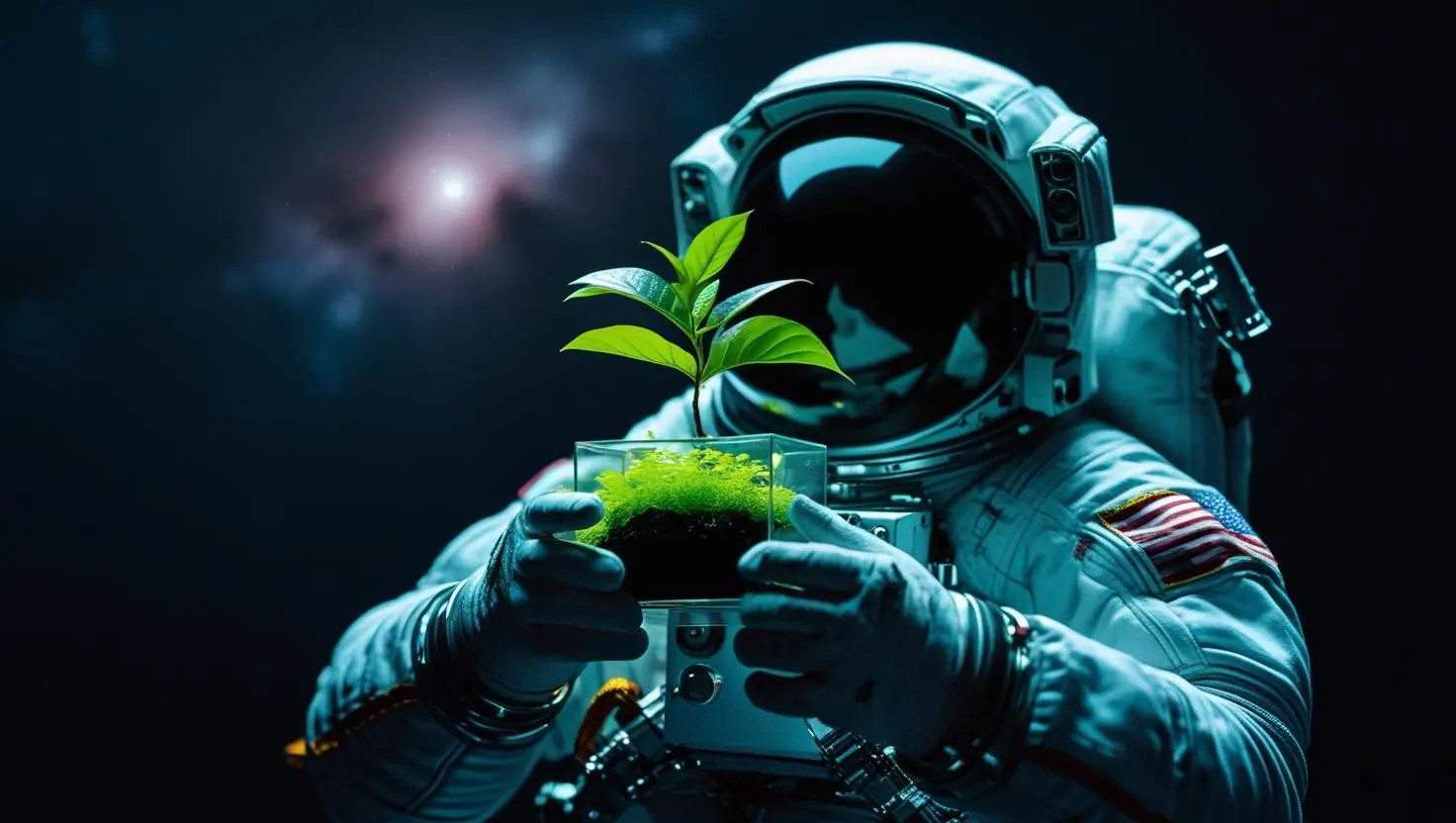
An astronaut in a spacesuit holds a small green plant
|

How Do You Water a Plant in Space?

Toggle Switch
Select Reading Level

Imagine you’re an astronaut floating on the International Space Station. You tip a watering can over a plant… and instead of water pouring out, it just stays in a ball, wobbling around in the air!

That’s because in space, there’s almost no gravity. And with no gravity, water doesn’t behave the way we’re used to. It won’t fall down. It won’t soak into soil. It just floats!

So here’s the big question: How do you water a plant when everything floats and there’s no “down”?

NASA is trying to find the answer with some very clever experiments. They’re called PWM-5 and PWM-6, and they’re happening right now aboard the International Space Station (ISS).

Let’s dive into what they’ve discovered and why it could help astronauts, future space farms, and even people back on Earth!

Why Grow Plants in Space?

In the future, astronauts might live on the Moon or even Mars for a long time. That means they’ll need fresh food.

Plants don’t just feed us. They also:

  • Make oxygen to breathe 
  • Clean the air 
  • Help astronauts feel happy and calm (a little green goes a long way!)

But to grow plants, we need to solve one BIG problem: how to water them properly when there’s no gravity to pull water down to the roots.

By the way- if you are interested in how we might live in space one day, and want to read how experts are solving another pressing problem- how to build bricks in space- check out this blog next

Water in Space = Wobbly Blobs

On Earth, gravity makes water flow down into the soil. Any extra water drains away so the roots don’t drown.

But in space, surface tension takes over. That’s the stickiness between water molecules. It makes water float in round blobs instead of pouring or soaking.

Check out astronaut Chris Hadfield showing how surface tension makes water form blobs in space. In the video, you can see how the blobs of water coat his hands rather than flow away.

Whilst this looks really cool it’s a problem for plants because:

  • Water might not reach all the roots evenly
  • Air pockets can get stuck and block water from getting in
  • Too much water can smother the roots

NASA’s Clever Trick: Let Water Move Itself!

The scientists at NASA found a smart solution: use the natural powers of water to move it around, without any pumps or machines.

How? With something called capillary action. That’s when water climbs through tiny spaces, like up a straw or through a sponge, even without gravity.

Check out this video if you want to learn more about capillary action.

The NASA Setup:

  • Tiny tubes and channels
  • Spongy materials that suck up water
  • 3D-printed parts that guide the water like a maze

It’s kind of like building a racetrack for water, and letting the water follow it all by itself!

 No Moving Parts = Nothing to Break

NASA’s watering systems work with no moving parts at all. They don’t use any pumps, valves or motors. 

Why is that awesome?

  • Less can go wrong (no broken pumps!)
  • Saves energy
  • Safer for astronauts
  • No need for tricky repairs in space

3D Printing & Magic Materials

NASA uses 3D printers to make special pieces called manifolds, these are like water traffic directors that send the water into the right channels.

If you aren’t sure what 3.D printing is check out this video:

The 3.D printed manifolds are:

  • Super light 
  • Easy to customize
  • Printable in space 

NASA also picks special materials that love water (called hydrophilic), so water spreads out where it’s needed. Things like sponges and wicks. 

To read about more smart materials make sure you check out our blog about smart fabrics next.

PWM-5 and 6 Explained

PWM-5:
Tests how water moves through a spongey block.
Uses no moving parts—just capillary action!
Delivers just the right amount of water to plant roots.

PWM-6:
A bit bigger and more complex than PWM-5.
Sends water upward into the root area.
Designed for plants that need a bit more water.
Uses clever shapes and layers to keep water evenly spread.

What About Bubbles?

One big win: bubble trouble – solved!

In space, bubbles don’t rise to the top like on Earth. They get stuck.

But PWM-5 and PWM-6 have super smart designs that:

  • Trap extra liquid
  • Catch bubbles and send them away
  • Keep the root zone bubble-free and happy!

In fact, NASA tested hundreds of thousands of bubbles and the system handled all of them with no moving parts. 100% success!

An infographic showing the problem of water movement in microgravity when watering plants and how PWM5 and 6 seek to solve it by using capillary action and 3.D printed materials.

What’s Next and Why It Matters

NASA is already working on PWM-7 and PWM-8, which will use more complicated systems to be able to water even bigger crops. And then the really fun part starts, testing the system on real-life plants. We know the technology works, but what happens when nature enters the picture?  

One day, this tech could help astronauts grow food on the Moon or Mars, and it could also help us here on Earth!

Imagine:

  • Watering plants in deserts
  • Saving energy in greenhouses
  • Using smart sponges instead of sprinklers.

It might even be helpful for doctors and scientists who often also need to be able to precisely control where and how water and other fluids move. 

So… Is Space Farming the Future?

Watering plants in space may sound small, but it’s a huge step for science.

If we can grow gardens in zero gravity, we’re one step closer to living and exploring far beyond Earth. And at the same time, we’re learning new ways to care for our planet too.

What kind of garden would you grow in space?

Here’s some ideas to spark a fascinating discussion.

  • What do you think would be the hardest part about growing food on Mars?
  • If you had to live in space for a year, what’s one food you’d miss the most?
  • If you were in space, what plant would you want to grow first?
  • Why do you think astronauts feel happier with plants around them?

Big Family Question:

What would be hard about being a gardener on the Moon?

Science is awesome. So is asking questions.

Learn how to spot real discoveries from made-up ones with our easy 4-step checklist.
It’s fun, printable and free! Grab yours below.

Want more cutting-edge science stories like these out-of-this-world watering tools? Then make sure you sign up for our Trailblazing Science newsletter below.

Keep Exploring

Want to see more amazing space science in action? Check out:

Let’s Talk About It

And now we’d love to hear your thoughts. Would you eat veggies grown in space? Why? Why not? Let us know below!

Related Posts

Leave a Reply

Your email address will not be published. Required fields are marked *