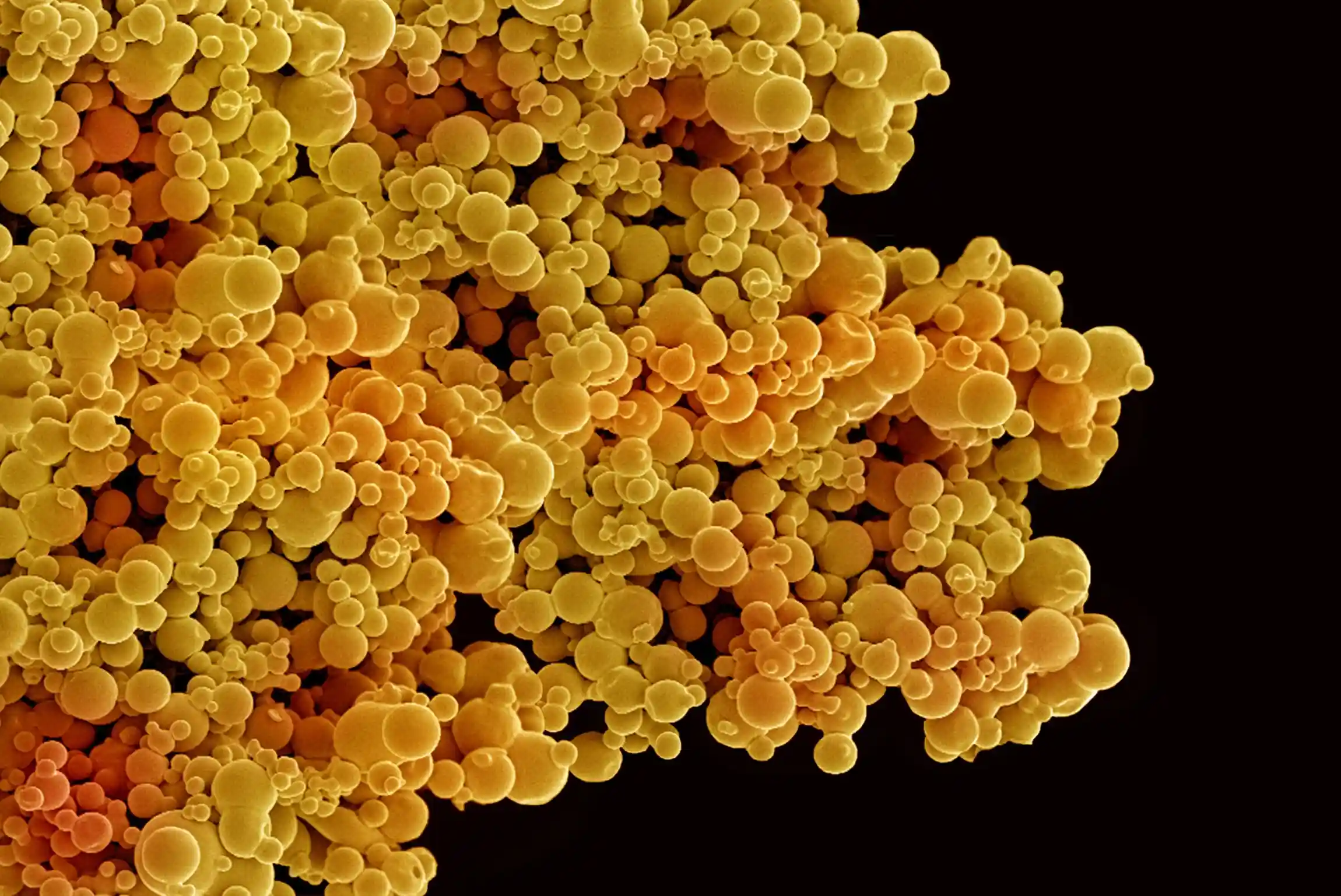
A cluster of small orange ball like structures against a black background. It is a microscope image of liposomes.
|

Sugar-Powered Nanotech for Precision Drug Delivery

Liposomes. Annie Cavanagh. Source: Wellcome Collection.

Toggle Switch
Select Reading Level

Mary Poppins once sang:

“A spoonful of sugar helps the medicine go down.”

A catchy song, but little did she know just how true that statement could become. Who would have thought that she might actually have been predicting the future of high-tech, ultra-precise nanoscale drug-delivery systems?

A mtal spoon containg sugar, Sugar is also seen o the tbale. It gives the feeling of the every day nature of sugar and is also reminiscent of the Mary Poppins song.

Photo by Immo Wegmann on Unsplash

Scientists at Stanford University have developed an intricate system that combines tiny “fatty bubbles” filled with sugar with ultrasound technology to deliver drugs exactly where they are needed and release them at precisely the right moment.

This system could open up a future of safer, faster-acting drugs with fewer side effects. 

From Mary Poppins to Willy Wonka


Sugary bubbles that drift through your body, ready to release their goodies whenever a beam of sound touches them, might sound like something straight out of Willy Wonka’s Chocolate Factory,  but this kind of magical medicine could be closer to reality than you think.

The researchers developed tiny bubbles made from lipids- or fats, called liposomes. When drugs are loaded into these liposomes, they are locked away from the human body, and are therefore inactive. At Stanford, they made these liposomes even more stable by adding sucrose….yes, simple table sugar. 

Imagine the liposome is a water balloon:

  • If it’s filled with pure water, it’s very floppy and easy to burst accidentally.
  • If it’s filled with a little syrup, it’s firmer, more stable, and bursts only when squeezed in a deliberate way.
a bucket of brightly coloured water balloons, they look fragile ad easy to pop

Photo by Aaron Burden on Unsplash

Sucrose turns the internal contents from “pure water” to “light syrup”, making the whole system behave in a reliable, controllable way.

How sound opens the bubble

Think of ultrasound like a remote-control switch for medicine release:

Step 1 – Ultrasound waves push and pull on the bubble
Ultrasound is pressure waves. They “squeeze and stretch” the liposome many thousands of times per second.

Step 2 – The membrane flexes and vibrates
The shell of the bubble wiggles like a drum skin being tapped.

Step 3 – Tiny pores momentarily open
The vibration creates temporary openings in the membrane (“sonoporation”).

Step 4 – The drug leaks out through these pores
Only when the ultrasound is turned on.

Step 5 – When the ultrasound stops, the membrane reseals
The pores close again, and the bubble stabilises.

Fine tuning with Sugar 

Another clever thing about the sugar is that it makes the liposome more sensitive to ultrasound waves.

The sugar makes the lysosome more likely to form these holes and less likely to just burst altogether. This means the scientists can more accurately control how, where and when the drug is released by using precise ultrasound beams. 

a metal spoon holds sugar, sugar can also be seen scattered on the table.

Photo by Alexander Grey on Unsplash

But why does any of this matter?

Because until now, ultrasound-controlled drug delivery has had some serious limitations…

Then vs now

Using nanosized “bubbles” to deliver drugs isn’t entirely new. What makes this study particularly exciting is that it only uses materials already known to be safe in the human body. Previous attempts relied on exotic or untested substances, which would take years of testing and regulatory approval before they could be used in humans.

Other earlier systems also had technical drawbacks: some required high-intensity ultrasound that heated the bubbles and surrounding tissues, posing a risk of damage. Many ultrasound-activated drug delivery methods either carry too little drug, are unstable in the body, or are difficult to use in real-life organs.

The new liposome system described in the paper addresses all of these issues. It is:

  • Small enough for safe intravenous use
  • Safe, with no dangerous heating of tissues
  • Stable in the bloodstream, preventing premature drug release
  • Activated by short, low-intensity ultrasound pulses, making it practical for real-world applications

Putting the System to the Test

To see whether their sugary, sound-responsive bubbles could actually work in living systems, the Stanford team tested the approach in animal models, a standard early step long before anything reaches human trials. They tried out two very different scenarios: one in the brain, and one in the leg.

1. Guiding ketamine precisely into the brain

a side view silhouette of a head. Inside a multiciloured image of the brain

Healthy adult human brain viewed from the side, tractography.Henrietta Howells, NatBrainLab. Source: Wellcome Collection.


In the first experiment, the researchers loaded ketamine into their sugar-stabilised liposomes and sent them circulating through the bloodstream. Ketamine isn’t just any drug, it shows promise for treating conditions like depression, chronic pain, and certain neurological disorders. But because it spreads widely through the brain and body, its effects can be unpredictable, making precise delivery a major advantage. Normally, only a small fraction reaches the intended region, and side effects like dissociation, dizziness, and hallucinations can occur.

In this study, the ketamine-loaded liposomes circulated harmlessly until a focused ultrasound beam triggered release in a specific brain area. The outcome: far more drug reached the target region, with much less exposure elsewhere.

2. A targeted nerve block, without a needle

A close up of a long needle, medicine dripping from it's tip

Photo by Raghavendra V. Konkathi on Unsplash


Next, they tested a local anaesthetic. After injecting the drug-loaded liposomes, they applied ultrasound to a single nerve in the leg. The result? That one nerve was temporarily blocked while nearby areas were completely unaffected. No needles, no invasive injections just a precise ultrasound pulse flicking open tiny doors in the right bubbles at the right moment.

Next steps

Perhaps most excitingly, Stanford says that a first human trial is already planned. That doesn’t mean we’re months away from new treatments,  medical translation is always slow and cautious, but it does mean the researchers believe this system has real potential to move beyond the lab.

The fact that all ingredients are already well-known to regulators gives this approach a major head start. Instead of designing a drug carrier from exotic materials that would take a decade to validate, this system uses components already familiar in human medicine. That could shave years off the approval process, if the technology continues to prove safe and effective.

Caveats

It’s important to remember that this research still has a long way to go before it could be used in hospitals around the world. Moving from laboratory disease models to real patients is a major leap. We don’t yet know whether the system will behave in the same way inside the complexity of the human body.

There are also practical hurdles ahead, including how to manufacture these liposomal, ultrasound-responsive drug carriers reliably and at scale. Many further studies will be needed to assess long-term safety, stability, and any potential side effects.

However, if these challenges can be overcome, this technology could be a genuine game-changer.

A runner crouches on the starting blocks- ready to move.

Photo by Braden Collum on Unsplash

It might be a marathon not a sprint but this technology is off the starting blocks

The Future could be sweet.  

Imagine a future where medicines don’t just enter the body, they navigate it. A future where a drug can be delivered directly into the right corner of the brain, quieting symptoms without collateral damage, or where a gentle pulse of sound replaces the sharp sting of a needle to numb a single nerve pathway with absolute precision.

And these are only the first hints of what might be possible. This platform could become a way to guide many different drugs exactly where they’re needed, when they’re needed, unlocking treatments we can barely imagine today.

Sometimes true innovation comes from surprising places. Combining something as everyday as table sugar with cutting-edge nanotechnology and ultrasound might just be the leap forward we need. Could future medicine release drugs only when and where we need them, without the baggage of side effects? Time will tell.


Here’s some ideas to spark a fascinating discussion.

  • Would you feel differently about taking a powerful drug if you knew it would only act on a single square-millimetre of your brain or body?
  • If ultrasound-activated drug delivery becomes widespread, which current medical procedures might become unnecessary, and how would that shift healthcare?
  • Is it more important for future medicines to be more effective or less invasive? Why?
  • How much risk should we accept when introducing a new drug-delivery system?
    Is it different when the materials (like sugar) are already known to be safe?

Big Family Question:

If this system were ready today, which medicines would you like to see used, for which conditions?

Looking for more family-friendly discussion prompts? Explore our child-focused version of this blog.

Curious but Cautious?

Love reading about incredible new science, but not always sure which claims to trust?
Grab our free guide: “5 Ways to Spot Fake Science News.”
It’s packed with quick, practical tips to help you tell real environmental breakthroughs from misleading headlines.

From nanotechnology to robotic surgeries, science is full of new ideas that may shape the future of healthcare.
Stay up to date with the latest stories and discoveries by signing up for our newsletter below.

Keep Exploring

Want to discover more ways science shapes our world?
Check out these stories next!

Smart Fabrics Transforming Healthcare, Space, and Robotics: 10 incredible inventions.

How Space Travel Ages Our Blood Stem Cells

Let’s Talk About It

Do you think this technology is realistic or too out there?
Share your thoughts or questions below and see how other readers are thinking about the future of drug delivery.

Related Posts

Leave a Reply

Your email address will not be published. Required fields are marked *