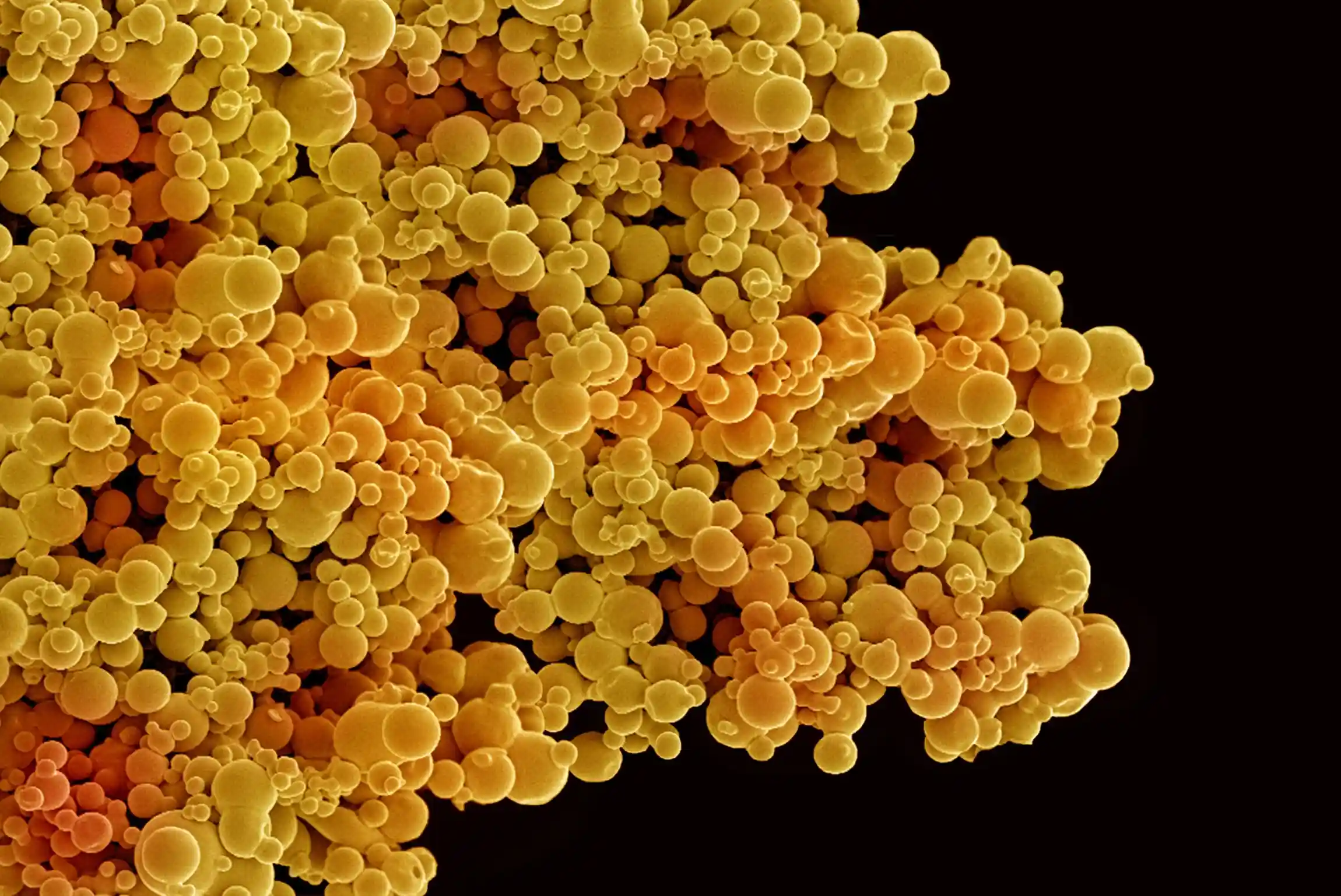
A cluster of small orange ball like structures against a black background. It is a microscope image of liposomes.
|

Sugar, Sound and Science: Tiny Bubbles That Heal

Liposomes. Annie Cavanagh. Source: Wellcome Collection.

Toggle Switch
Select Reading Level

“Just a… spoonful of sugar helps the medicine go dooooown!”

A mtal spoon containg sugar, Sugar is also seen o the tbale. It gives the feeling of the every day nature of sugar and is also reminiscent of the Mary Poppins song.

Photo by Immo Wegmann on Unsplash


You know that song from Mary Poppins? Well, it turns out it might actually be true! Scientists have found a clever way to use sugar to help medicines travel to exactly the right place inside the body.

At Stanford University, researchers made teeny-tiny bubbles out of fat and filled them with sugar and medicine. Then they used a special kind of sound to tell the bubbles when to let the medicine out. That way, the treatment goes to the right spot, right when it’s needed.

Pretty amazing, right? Let’s find out how these magical-sounding bubbles actually work!

From Mary Poppins to Willy Wonka

Sugary bubbles drifting through your body, ready to release their goodies whenever a beam of sound touches them, might sound like something straight out of Willy Wonka’s Chocolate Factory but this magical-sounding medicine could be closer to reality than you think.

The scientists created tiny bubbles made from fats, called liposomes. When medicine is packed inside these bubbles, it stays safely hidden away, almost like someone pressed pause so it can’t affect the body yet. 

Here’s the clever twist: the Stanford team added sugar (yes, the same kind you might sprinkle on your cereal) to make the bubbles stronger and less likely to burst at the wrong time.

Imagine a liposome like a water balloon:

  • A water balloon filled only with water is floppy and easy to pop.
  • But if you fill it with something thicker, like syrup, it becomes firmer and only bursts when you really squeeze it.
a bucket of brightly coloured water balloons, they look fragile ad easy to pop

Photo by Aaron Burden on Unsplash

Adding sugar turns the watery bubble into a “light syrup” bubble, sturdier, steadier, and much easier for scientists to control. That means they could use these bubbles to carry medicines around the human body.

How sound can open the bubbles

The scientists used something like ultrasound to control the bubble 
It’s a type of sound, a super high-pitched kind that humans can’t hear. Dogs, bats, and dolphins use sounds like this all the time! Even though we can’t hear it, ultrasound still travels through the body as tiny waves of pushes and pulls. Scientists can aim these waves at a very specific spot, a bit like shining a flashlight exactly where you want it.

Think of ultrasound like a remote-control switch for medicine release:

Step 1 – Waves push and pull the bubble
Ultrasound squeezes and stretches the bubble thousands of times every second.

Step 2 – The bubble wiggles
Its outer shell moves like the skin of a drum being tapped.

Step 3 – Tiny holes appear
The wiggling makes very small openings in the bubble.

Step 4 – Medicine escapes
The drug leaks out only while the ultrasound is on.

Step 5 – The holes close
When the ultrasound stops, the bubble stops wiggling and the tiny openings disappear.

This smart system is a big leap forward. 

Why this is so clever


The sugar-filled bubbles aren’t just cool, they’re smart! The sugar helps the bubbles stay strong and makes it easier for the scientists to tell them exactly when and where to release the medicine.

a metal spoon holds sugar, sugar can also be seen scattered on the table.

Photo by Alexander Grey on Unsplash

This is important because if medicine spreads everywhere, it can make people feel sick, or it might not work as well where it’s really needed. By sending the medicine only to the right spot, it can work better and be safer.

Putting the System to the Test

To see if their sugar-filled, sound-sensitive bubbles really worked, the Stanford team ran some experiments. They wanted to see how the bubbles behaved in two very different parts of the body: one in the brain, and one in the leg.

1. Guiding Medicine to the Brain

a side view silhouette of a head. Inside a multiciloured image of the brain

Healthy adult human brain viewed from the side, tractography.Henrietta Howells, NatBrainLab. Source: Wellcome Collection.

For their first test, the scientists put ketamine, a medicine that can help with things like feeling really sad or pain that won’t go away, inside their sugar-filled bubbles. Normally, when ketamine goes into the body, it spreads everywhere in the brain, which can make people feel dizzy or confused.

But in this experiment, the bubbles carried the medicine safely through the blood until the scientists used a special sound beam to tell them exactly where to open up. The result? Most of the medicine went right to the spot in the brain that needed it, and very little went anywhere else.

2. A Numb Spot, Without a Needle

Next, the scientists tested a numbing medicine, a drug that can stop a part of your body from feeling pain.

A close up of a long needle, medicine dripping from it's tip

Photo by Raghavendra V. Konkathi on Unsplash

Usually, doctors have to use a needle and get very close to a nerve to deliver this numbing medicine. This can be tricky and sometimes numbs more than needed. This time, the numbing medicine was put inside the sugar-filled bubbles and sent through the blood. Then the scientists used a special sound beam to tell the bubbles exactly where to open, just at one nerve in the leg.

The result? Only that nerve got numbed, while everything around it stayed normal. No needles, no tricky injections, just a tiny, precise “unlocking” of the bubbles with sound.

What We Still Need to Learn

This research is definitely super cool, but it will still be a while before these sugary bubbles make it to doctors’ offices around the world. Lots more tests are needed to see how the bubbles behave inside our bodies. Scientists also need to figure out how to make enough bubbles for people and double-check, triple-check, even quadruple-check that they are safe before anyone gets them.

But if all these tests work out, these bubbles could change the way we give medicine forever!

The Future Could Be Sweet

Imagine if medicines could travel exactly where they’re needed, no guessing, just a tiny pulse of sound.
These sugary bubbles show that one day this might really happen.
It’s amazing what can come from something as simple as sugar and sound!

Here’s some ideas to spark a fascinating discussion.

  • Why do you think medicines sometimes need help getting to the right place in the body?
  • Why might it be helpful for doctors to use less medicine overall, instead of more?
  • If you could invent a kinder, gentler way to deliver medicine without needles, what would it look like?
  • Why do you think scientists test ideas many times before giving them to people?

Big Family Question:

If you could design your own “smart medicine bubble,” what everyday ingredient would you choose to help it and why?

Science is awesome. So is asking questions.

Learn how to tell real science stories from made-up ones with our fun, easy 4-step checklist — it’s printable and free! Grab yours below.

 NEVER MISS A DISCOVERY
Loved finding out how sugary bubbles could help medicines reach their target?
Sign up for our newsletter and keep exploring more surprising inventions that will shape our future.

Keep Exploring

Want to discover more ways science shapes our world?
Check out these stories next!

Shrinking Down to See a Hidden World: The Story of CL

Smart Fabrics: Amazing Inventions Changing Healthcare, Space and Robots

Let’s Talk About It

Do you find the idea of sound-guided sugary bubbles exciting?
Post your thoughts below and see what other curious readers think too!

Related Posts

Leave a Reply

Your email address will not be published. Required fields are marked *