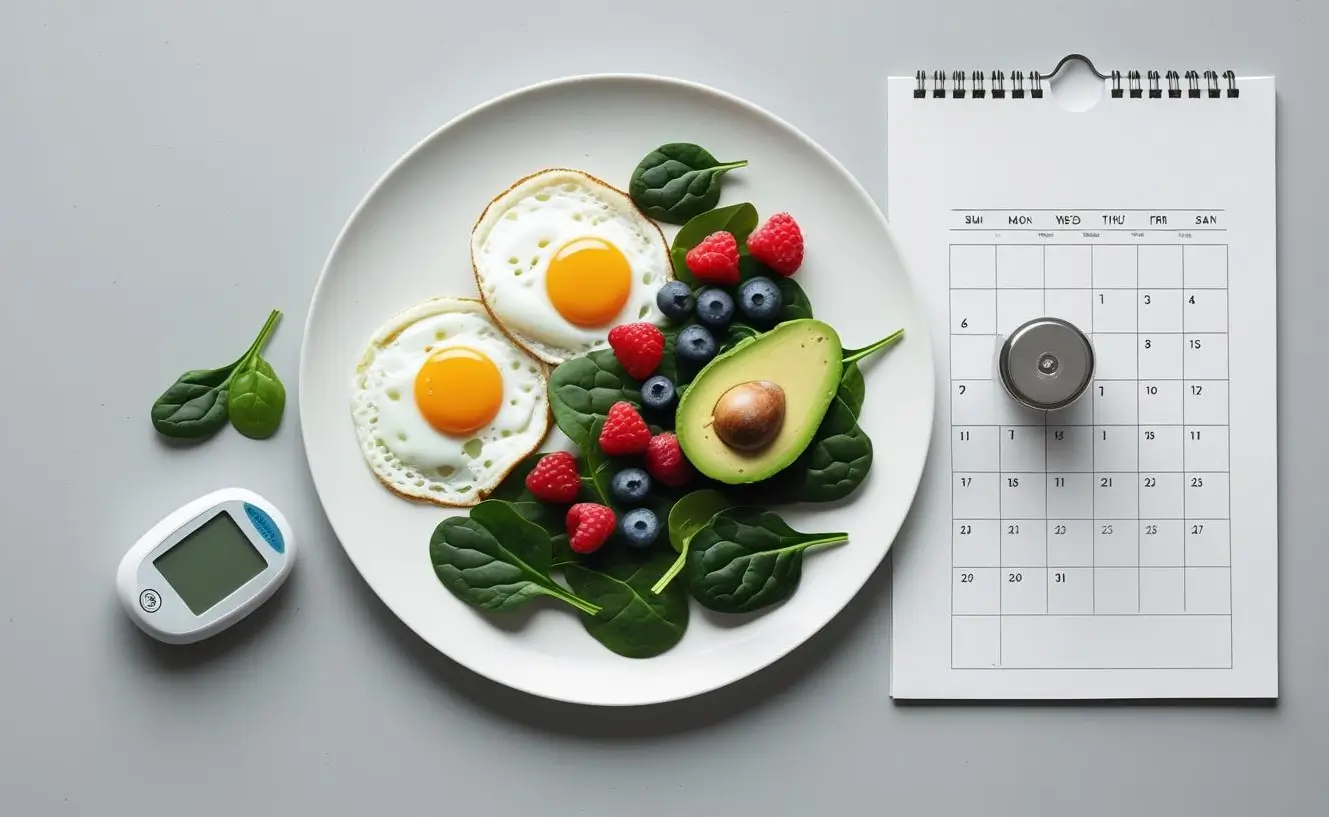
A clean, minimal flat-lay image on a light gray surface. Centered is a pristine white plate featuring vibrant, fresh ingredients: dark green spinach, bright red raspberries and blueberries, two sunny-side-up eggs, and half a creamy avocado. To the upper right of the plate, a simple, uncluttered calendar page is partially visible, subtly suggesting a meal plan. Discreetly placed near the lower left of the plate is a small, modern glucose meter, hinting at health management. The overall aesthetic is bright, airy,

Fasting Crushes Diabetes? Not so Fast! 

Toggle Switch
Select Reading Level


Twice-a-week fasting CRUSHES Type-2 Diabetes: Insulin resistance defeated by autophagy

A recent NEWS headline

Fasting crushes diabetes? That’s a bold claim. Some 589 million adults across the world suffer from type 2 diabetes. That’s 1 in 9 adults. And this is predicted to rise to 853 million adults by 2050Worryingly, diabetes is growing fastest in low- and middle-income countries, where people often lack access to early treatment, putting them at higher risk of serious complications. 

Diabetes affects nearly every system in the body and can lead to life-altering or life-threatening complications if not managed well. So, if we could really ‘crush’ it with something as simple as fasting, this would be a real game changer.

But as always with anything in the news- if it sounds too good to be true, there is a good chance it is- so let’s put this article through the Trailblazing Science Clickbait Checker and see how it holds up. 

What does the article claim? 

According to the article, the 5:2 intermittent fasting diet can “crush” type 2 diabetes. This type of diet involves eating normally for 5 days and a severely calorie-restricted diet for 2 days.

The article suggests that by fasting, insulin resistance is ‘defeated’ by autophagy. Autophagy is the body’s way of cleaning up and recycling waste products. All our cells contain bits of broken proteins, chunks of damaged cells, and old, worn-out cellular machinery. During autophagy, our cells package this waste up, recycle the useful parts and digest the rest. This keeps the cell healthy. 

The article also suggests that insulin treatment worsens insulin resistance and that mainstream medicine promotes insulin dependence rather than cures. 

What the Study Actually Says

These are all big claims, but what does the science actually say? 

This news report was based on a press release which came from the Endocrine Society’s 2025 annual meeting.

Let’s take a closer look at the press release. The study was a small preliminary clinical trial involving 63 patients. They split the group into subgroups and were randomly assigned different diets.

Some followed the 5:2 diet, another group general calorie restriction and the third group was instructed to only eat during ten hours each day.

They found the folowing:

  • Blood sugar levels improved in all groups.
  • More people were able to stick to the 5:2 diet.
  • The best improvements in reducing fasting blood glucose and improving insulin sensitivity were found in the 5:2 diet group. 

This study appears to be promising but has yet to be put through peer review (more on that later).

What the study doesn’t say

The news report concentrated heavily on autophagy. This is certainly a powerful natural process taking place in our cells as we read this. Autophagy is indeed a mini marvel. It keeps our cells healthy and has been linked to insulin sensitivity by multiple studies.

Scientists are keen to explore whether we can use our knowledge of autophagy to develop treatments for a wide variety of diseases. However, certain aspects of the media like to sensationalise the results and claim autophagy can ‘cure cancer, reverse ageing or crush diabetes’ when in fact the research is still in its early stages. And whilst autophagy is beneficial, it’s just one part of a complex network of actions. 

A man injects insulin into his leg

Photo by Swwet Life on Unsplash

The scientific report also certainly does not say that fasting should replace insulin injections for those who have been medically recommended it or that insulin therapy worsens resistance. This is a common misbelief.

All scientific evidence points to insuli resistance developing before insulin is given as a treatment, and that insulin treats, not causes, resistance. Insulin is no ‘metabolic trap’ but an important treatment which prevents devastating complications for some people with diabetes. The demonisation of insulin treatments is not only misleading but dangerous.

Red Flags 

This headline is a classic clickbait red flag. Phrases like ‘crushes diabetes’ and ‘defeated by autophagy’ dramatically exaggerate the more cautious, promising results found in the actual study. A good rule of thumb: the more extreme the language, the more scepticism is warranted.

A fake news checklist. Red flags stand next to the catagories-, Lost in Translation, Big Talk no data, Headline hijinks, over generalisation, too good to be true and Peer-review problems.

It is also important to note that this article is based on a press release and NOT a peer-reviewed study. In the 5 Quick Ways to Spot Fake Science News guide, we explain exactly why peer review is so important. Peer review is a kind of quality control in science. Before a study gets published in a serious scientific journal, it’s reviewed by other experts who weren’t involved in the research.

They check whether the methods were solid, the data make sense, and the conclusions aren’t jumping ahead of the evidence. That doesn’t guarantee perfection, but it does help weed out weak or misleading claims. The press release we’re looking at here is based on a conference presentation, not a peer-reviewed paper (at least, not yet).

That means we haven’t seen the full data, and no independent scientists have formally reviewed it. So while the early results might be interesting, we need to be extra cautious about any bold headlines or health promises attached to them. This is not to say the press release is not accurate. But before we draw any fixed conclusions, we should wait to see the full paper. 

Finally, the news report makes sweeping claims, suggesting that the study “proves” fasting could be a universal cure for type 2 diabetes. But that’s a huge oversimplification. Diabetes is a complex condition, and every person’s body responds differently. It’s highly unlikely that one single solution will work for everyone. What’s more, the study behind the press release was small and preliminary, involving just 63 participants. While the early results are promising and suggest that intermittent fasting might help as part of a broader treatment plan, we need much larger and longer-term studies before we can draw conclusions or apply this approach to the wider population.

A Test tube with the words 'clickbait concentration written above it. And '70%' written below it. On the side are the measurement marks- low, moderate, high and full bait Mode. A red liquid fills to the 70% mark. The rest is a blue liquid. It represents an approximation of how much of the article was fake news vs accurate science

Clickbait is never good. But clickbait or fake news in health news is perhaps the most dangerous kind. Exaggerated or misinterpreted results can create either confusion or false hope. This can cause people to make treatment decisions which they believe are evidence-based but are, in fact, based on inaccurate reporting. We must allow people to make fully informed decisions through balanced and evidence-based reporting. 

How to Spot Clickbait or Fake News Yourself

So, how can you protect yourself against this type of sensationalist reporting? In the modern world, we are exposed to a confusing and exhausting onslaught of information. Without being an expert in every single research area, how on earth are we meant to wade through this flood of data and separate fact from fake news? 

A young Hispanic woman with shoulder-length dark hair, wearing a simple denim jacket and jeans, stands at a crossroads, looking perplexed. In one hand, she holds a crumpled newspaper; in the other, a smartphone. To her left, a road sign displaying "Clickbait" features flashy, neon headlines and vibrant, attention-grabbing colors. To her right, a contrasting sign reading "Real Science" is displayed in calm, muted tones and features a simple magnifying glass icon. The scene is brightly lit, with a realistic style emphasizing the contrast between the two paths.

Well, the first step is just to be aware of the problem. If we approach each article with a certain degree of critical thinking, we are already one step ahead of the game. Being cautious if an article seems too good to be true, or trying to invoke fear and panic in us is always a good idea. 

To get more tips and to learn how you can protect yourself from false claims, download your free guide, 5 Ways to Spot Fake Science News, below. 

Equiping Future Generations

Our children are growing up in a world flooded with fake science news and it’s only going to get harder to sort fact from fiction. That’s why Trailblazing Science is here to help kids build the tools they need to think critically and navigate the media they consume. We’ve created a free, kid-friendly guide to spotting dodgy science stories and asking the right questions. Just click on the child version of this blog at the top, then scroll to the end of the article to grab your copy and help your child build their science-sense superpower.

Want to Read REAL Health Stories?

How about Microrobots Fighting Lung Disease?

Or Smart Fabrics transforming Healthcare, Space and Robotics?

Or maybe you’d love to discover how scientists are Untangling the Link Between ADHD, Dyslexia & Dyscalculia

Related Posts

Leave a Reply

Your email address will not be published. Required fields are marked *