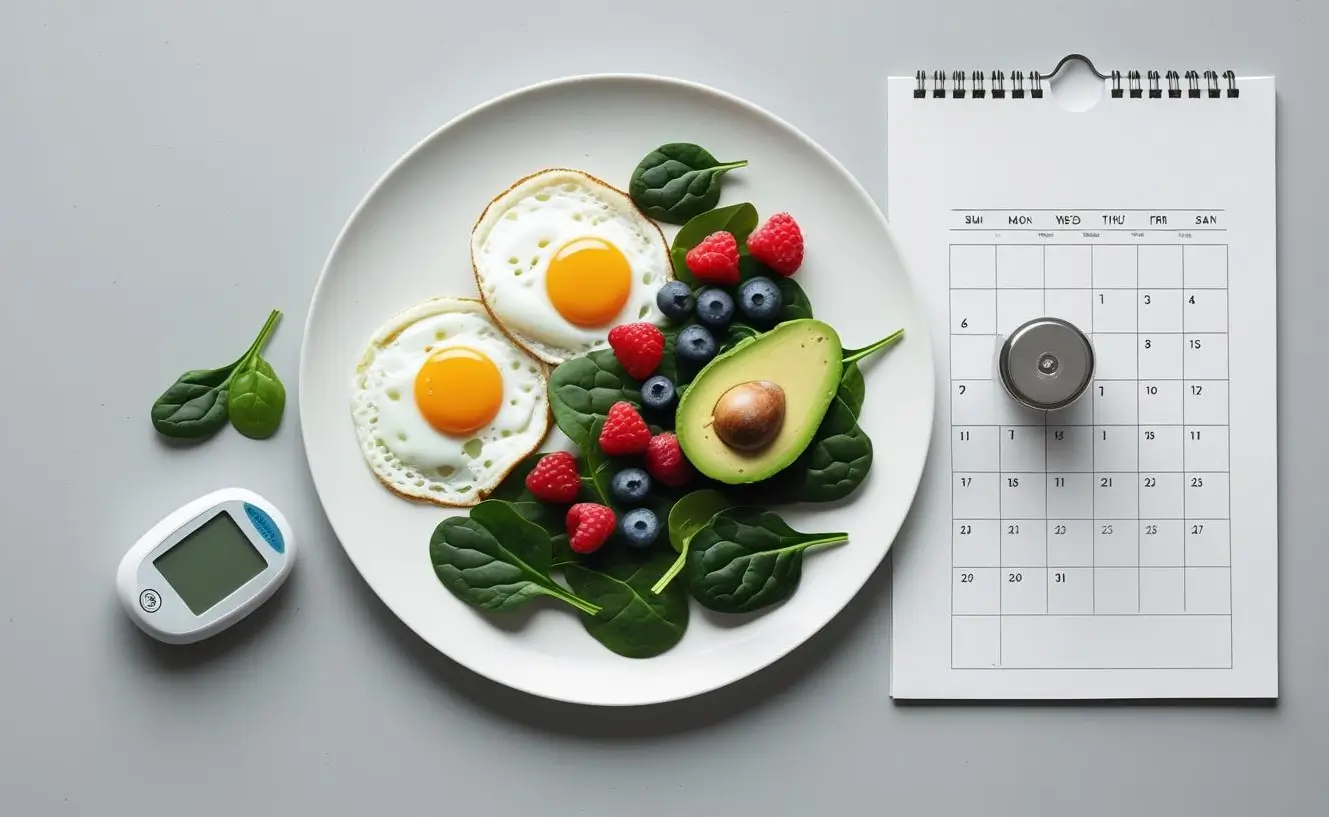
A clean, minimal flat-lay image on a light gray surface. Centered is a pristine white plate featuring vibrant, fresh ingredients: dark green spinach, bright red raspberries and blueberries, two sunny-side-up eggs, and half a creamy avocado. To the upper right of the plate, a simple, uncluttered calendar page is partially visible, subtly suggesting a meal plan. Discreetly placed near the lower left of the plate is a small, modern glucose meter, hinting at health management. The overall aesthetic is bright, airy,

Fasting Crushes Diabetes? Let’s Check the Science!

Toggle Switch
Select Reading Level

A new article online says that fasting can “crush” type 2 diabetes- or in other words, changing the way we eat can cure one of the biggest diseases. That sounds amazing! But is it true?


Twice-a-week fasting CRUSHES Type-2 Diabetes: Insulin resistance defeated by autophagy

A recent NEWS headline

Let’s put it through the Trailblazing Science Clickbait Checker to find out. And don’t forget to grab your free copy of “Is It Real or Rubbish? A Science News Checklist for Curious Families” at the end to learn just why people write ‘fake news’ and how to spot dodgy science stories like a pro!

Wait… What Is Fasting, Anyway?

Fasting means not eating for a set amount of time. Some grown-ups choose to fast for part of the day or a couple of days a week, like in the 5:2 diet, where you eat normally for 5 days and eat very little for 2.

But here’s something important:
Fasting is not for kids!
Your body is still growing and needs regular meals, snacks, and all sorts of nutrients to stay strong and healthy. If you’re worried about health or food, talk to a parent or a doctor, don’t try fasting yourself.

What’s Type 2 Diabetes and Why Does It Matter?

Type 2 diabetes is a disease that affects how your body uses sugar for energy. Every part of our body needs sugar or glucose to work. We can get this from the food we eat. Insulin is a special chemical our body makes which helps this sugar move from your blood into your cells. Diabetes happens when the body either doesn’t make insulin or it doesn’t work properly. If diabetes is not treated, it can lead to serious health problems like damage to your heart, eyes, and kidneys.

Right now, over 589 million people around the world have it. That’s nearly 1 in every 9 grown-ups! And more and more people are getting it every year, especially in places where it’s harder to get good medical care.

So if something simple like fasting could really stop diabetes, that would be incredible. But… is it that simple?

What Does the Article Claim?

The article says that a special eating plan called the 5:2 fasting diet can “crush” diabetes by fixing insulin problems.

It also talks a lot about something called autophagy, which is how your cells clean up and recycle old parts. it’s like your cells taking out the trash and reusing the good bits. The article says that autophagy can “defeat” insulin resistance.

But what does the science say?

What the Study Actually Says

This news story comes from a press release shared at a science meeting, not from a full scientific paper that’s been checked by other experts (more on that soon!).

The research looked at just 63 people who tried different types of diets: some did 5:2 fasting, others just ate less food, and another group ate all their food within 10 hours each day.

All of them had better blood sugar levels, but the 5:2 group found it easier to stick with the plan and had slightly better results. Sounds promising, right?

It is, but it’s also very early research and hasn’t been officially checked over for mistakes.

What the Study Doesn’t Say

The news article says that insulin injections, a common diabetes treatment, might make diabetes worse. But that’s just not true.

Doctors and scientists have studied this a lot, and insulin is a life-saving medicine for people whose bodies can’t make enough of it. It doesn’t “trap” people, it helps them stay healthy and avoid scary complications.

A man injects insulin into his leg

Also, while autophagy is super cool, we’re still learning how it works in diseases like diabetes. It’s not a magic fix!

Clickbait Alert!

Words like “crush,” “defeat,” and “cure” in science headlines are big red flags. These words make the story sound super exciting, like there’s been a major breakthrough. But often, they stretch the truth or leave out important details.

When you see words like that, it’s a good idea to pause and ask:

  • Does this headline sound a bit too amazing to be real?
  •  Is it trying to grab attention with drama instead of facts?
  • Did scientists actually say this, or is the reporter exaggerating?

Sometimes, a study shows something interesting or hopeful, but that doesn’t mean it’s a magic fix for everyone. Headlines with extreme words can make it sound like the problem is totally solved… when really, the science is just getting started.

A fake news checklist. Red flags stand next to the catagories-, Lost in Translation, Big Talk no data, Headline hijinks, over generalisation, too good to be true and Peer-review problems.

If a headline promises a superpower or miracle cure, it’s time to pull out your “Is It Real or Rubbish?” checklist and take a closer look.

Remember headlines often exaggerate the truth just to get you to click on the article and read it. 

What’s Peer Review and Why Does It Matter?

Before scientists share their results in a real science journal, the study gets checked by other experts. That’s called peer review. These reviewers make sure the methods are good, the data makes sense, and the conclusions are fair.

The study in this article? It hasn’t been through peer review yet, so we need to be extra careful about trusting it. We haven’t seen all the details, and it might even change when it does get published.

So… Is This Real or Rubbish?

A Test tube with the words 'clickbait concentration written above it. And '70%' written below it. On the side are the measurement marks- low, moderate, high and full bait Mode. A red liquid fills to the 70% mark. The rest is a blue liquid. It represents an approximation of how much of the article was fake news vs accurate science

This study is interesting and the results might help scientists learn more about how food and fasting affect diabetes. But it definitely doesn’t prove that fasting cures diabetes for everyone. That’s a huge overstatement.

Diabetes is a complicated condition, and everyone’s body is different. What works for one person might not work for another. We need more research with bigger groups of people before we can make big claims like this one.

So, is fasting a helpful tool? Maybe! Is it a cure? Not so fast.

How Can You Spot Fake Science News?

A young Hispanic woman with shoulder-length dark hair, wearing a simple denim jacket and jeans, stands at a crossroads, looking perplexed. In one hand, she holds a crumpled newspaper; in the other, a smartphone. To her left, a road sign displaying "Clickbait" features flashy, neon headlines and vibrant, attention-grabbing colors. To her right, a contrasting sign reading "Real Science" is displayed in calm, muted tones and features a simple magnifying glass icon. The scene is brightly lit, with a realistic style emphasizing the contrast between the two paths.

We know it’s hard to tell what’s true online. That’s why we made a free guide just for kids and families called “Is It Real or Rubbish? A Science News Checklist for Curious Families.” It’ll help you ask the right questions next time you see a wild science headline.

 Just scroll to the end of this article to download your copy!

And remember: when a headline sounds too good (or too scary) to be true… it just might be.

Want to Read REAL Medicine Stories?

How about Tiny Robots Fighting Lung Disease?

Or Smart Fabrics: Amazing Inventions Changing Healthcare, Space and Robots?

Or maybe you’d love to discover how scientists are discovering why ADHD, Dyslexia & Dyscalculia often come together

Related Posts

Leave a Reply

Your email address will not be published. Required fields are marked *