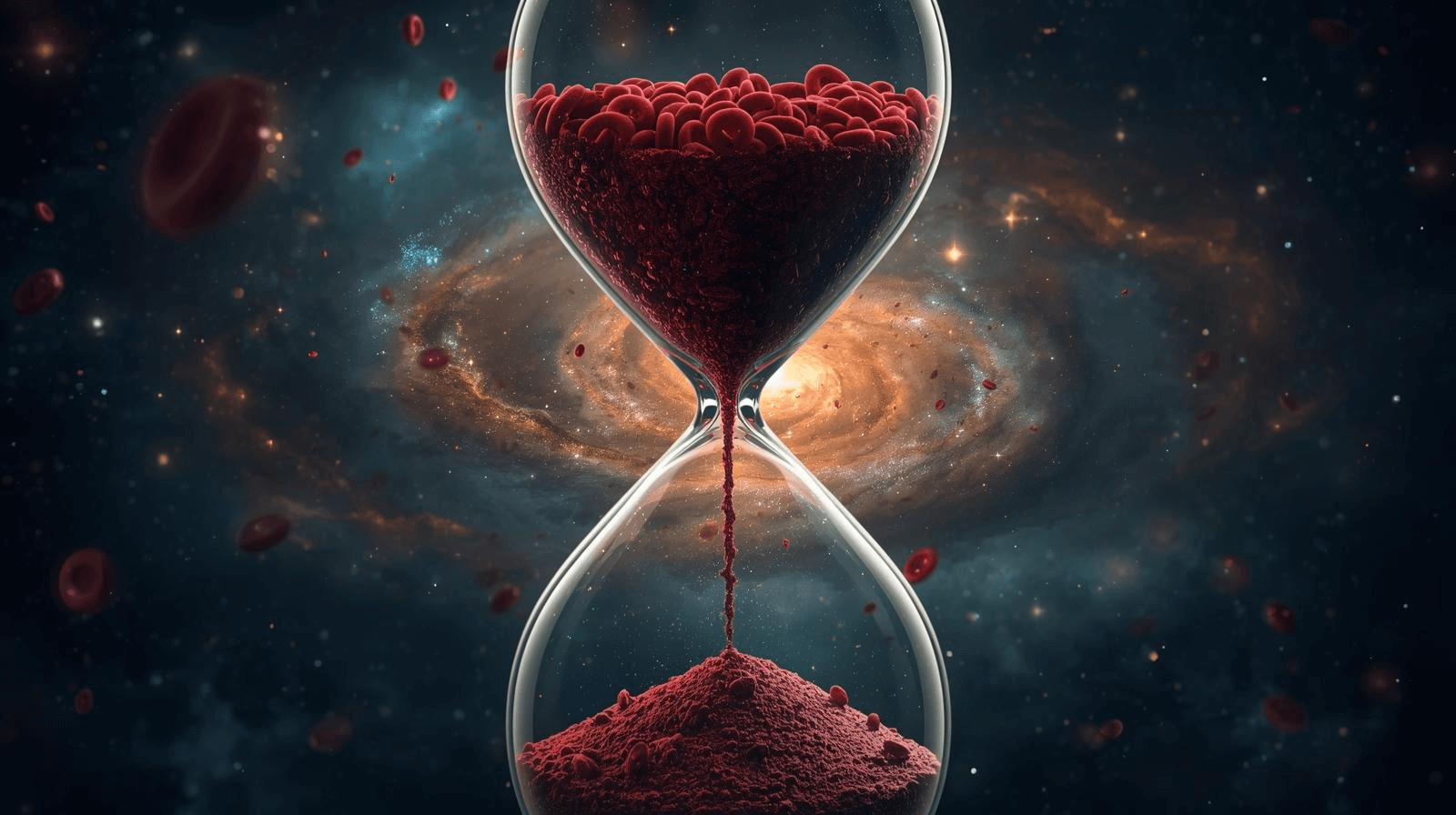
An hourglass filled with blood cells in the top half drains like the sands of time into the bottom, where the cells are broken up and more sand-like. In the background, we can see a swirling galaxy. It represents the concept of them stem cells degrading over time in space
|

How Space Travel Ages Our Blood Stem Cells

Toggle Switch
Select Reading Level

Astronauts may return to Earth looking triumphant, but inside their bodies, time seems to move faster.
A new study shows that just a month in space can accelerate ageing in human blood-forming stem cells.

An astronaut wearing a white spacesuit smiles at the cameras and gives a thumbs-up. She is being supported by three people in black jumpsuits. It is clear she has just landed.

NASA astronaut Anne McClain is helped out of the SpaceX Dragon Endurance spacecraft. NASA Headquarters / NASA/Keegan Barber, Public domain, via Wikimedia Commons

What are Blood Stem Cells?

Hematopoietic stem and progenitor cells (HSPCs for short) normally live in the spongy marrow at the centre of our bones. They are vital because they generate every type of blood cell: red cells that carry oxygen, white cells that fight infection and help prevent cancer, and platelets that stop bleeding after injury. When HSPCs decline with age, our entire blood and immune system weakens, making it harder to resist disease or recover from illness.

Spaceflight adds unique stresses. Microgravity alters how fluids, such as our blood, move and how cells sense their environment, while cosmic radiation damages DNA. We already know that astronauts’ muscles, bones, and DNA are affected, but until now we’ve known little about how these forces influence HSPCs. Understanding that process matters not only for long-duration missions to the Moon or Mars, but also for what it can teach us about ageing and human health here on Earth.

Studying Stem Cells in Space

Scientists at the University of California, San Diego, in collaboration with the International Space Station, wanted to understand how the stresses of spaceflight affect our blood-forming stem cells. They collected HSPCs from the bone marrow of healthy donors and sent them on four-month SpaceX missions, while keeping cells from the same donors on Earth as a control.

Onboard, the cells were grown in a high-tech “mini-lab” using tiny 3D culture systems that closely mimic conditions inside the human body. Special fluorescent markers allowed researchers to watch each cell as it grew and divided, while artificial intelligence software tracked individual cell “families” in real time. This setup let the team measure multiple aspects of cellular ageing simultaneously and see how each stem cell responded to space conditions.

An image of the equipment the scientists used to monitor the cells. Someone wearing a white coat and purple lab gloves is operating it.

The scientists used high-tech monitoring equipment to study the cells. Pham J, Isquith J, Balaian L, et al. Nanobioreactor Detection of Space-Associated Hematopoietic Stem and Progenitor Cell AgingCell Stem Cell. 2025;32(9):1403-1420.e8. doi:10.1016/j.stem.2025.07.01

To track ageing, they measured:

  • Regenerative Capacity: The ability of stem cells to produce new blood cells. Lower capacity signals a weakened blood and immune system.
  • DNA Damage: Breaks or errors in DNA, which can indicate ageing and early cancer risk.
  • Telomere Shortening: Protective caps on chromosomes called telomeres shrink over time, limiting cell lifespan.
  • Mitochondrial Stress: Mitochondria are the cell’s energy factories. Stress here can accelerate ageing and reduce function.
  • Inflammatory Responses: Overactive inflammation can harm tissues and interfere with blood and immune cells.
  • Genomic Instability: Normally silent DNA regions become active, potentially causing errors or abnormal cell behaviour.

Space Speeds up Cellular Ageing

Compared to their Earth-bound counterparts, blood stem cells sent to space exhibited more DNA damage, shorter telomeres, and increased mitochondrial stress. They also displayed genomic instability, heightened inflammatory responses, and reduced regenerative capacity. Altogether, these changes provide clear evidence that spaceflight accelerates cellular ageing in human blood stem cells.

A graphical abstract of the paper. It shows all the changes seen in the stem cells after being in space.

Pham J, Isquith J, Balaian L, et al. Nanobioreactor Detection of Space-Associated Hematopoietic Stem and Progenitor Cell AgingCell Stem Cell. 2025;32(9):1403-1420.e8. doi:10.1016/j.stem.2025.07.01

Interestingly, not all donor cells were affected equally. Some showed fewer signs of ageing, suggesting that genetic factors or other inherent protections may help shield certain individuals from the stresses of space. This study represents the first direct evidence that spaceflight can speed up the ageing of HSPCs, highlighting important considerations for long-term human missions beyond Earth as well as potential insights into ageing and regenerative health on our home planet.

Implications for Long-Term Space Travel

The dream of extended space missions has already overcome many challenges. At Trailblazing Science, we’ve previously covered how researchers can repair lunar bricks using bacteria and how NASA figured out how to water plants in microgravity. Yet these new findings, alongside other evidence of space-related health effects, raise fresh concerns for those planning long-term missions or extraterrestrial bases.

Our bodies evolved for life on Earth—they are not built for microgravity or the heightened radiation outside Earth’s protective atmosphere. To explore the outer reaches of the solar system or establish a home on Mars or the Moon, we must fully understand these health risks and identify ways to mitigate them. The effects of space travel may accumulate over multiple missions, adding another layer of complexity to mission planning.

With the rise of commercial spaceflight, these red flags are even more significant. Understanding how space accelerates cellular ageing is essential not just for astronauts’ safety, but also for designing strategies to protect human health on long-duration missions.

Implications for Science and Medicine on Earth

Discoveries made in space, or technologies developed for space missions, often have profound applications here on Earth. A great example is telerobotic surgery: originally designed to allow medical procedures in space, it now helps patients in hospitals far from specialist surgeons (read more on the Trailblazing Science blog).

Studying how blood stem cells age in space provides similar opportunities. These findings help us understand why cells sometimes age faster, the processes behind DNA repair, mitochondrial health, and resilience to stressors. They may also reveal why some people maintain robust, “youthful” immune systems into old age, while others do not.

By uncovering the cellular mechanisms influenced by extreme environments like space, this research offers insights that could guide strategies to promote healthy ageing, improve immune function, and even inform treatments for age-related diseases on Earth.

What’s Next: Countermeasures and Future Research

This research opens exciting new questions. Scientists want to understand why some donor cells appeared more resistant to the stresses of space. They are also exploring whether interventions, such as antioxidants, artificial gravity, radiation shielding, or targeted drugs, could reduce or prevent the cellular ageing observed.

Importantly, these insights extend beyond space travel. If we can mitigate blood stem cell ageing, we may one day help people maintain healthier immune systems for longer or protect cells from everyday stressors, including medical treatments like radiation therapy. The findings could ultimately guide strategies for both space missions and improving human health on Earth.


Long-term space travel and extraterrestrial bases are undeniably exciting, but they pose serious biological challenges. Do studies like this reveal a challenge to overcome or a limit on human exploration? Only time will tell.  What is clear: some of the deepest insights into how our bodies function may come not from Earth, but from journeys far beyond our familiar world.

Here’s some ideas to spark a fascinating discussion.

  • Should humans modify their biology to live on other planets, or adapt planets to humans?
  • How much risk is acceptable for human exploration, should we prioritize safety or discovery?
  • If we could one day genetically modify astronauts’ HSPCs to protect them from radiation risks, should we?
  • Should we invest in studying how space affects stem cells, or focus on health problems on Earth?

Big Family Question:

If long-term space travel slows ageing in some ways but accelerates it in others, would you still go?

Looking for more family-friendly discussion prompts? Explore our child-focused version of this blog here.

Curious but cautious?

Love exploring cutting-edge research but not always sure what to trust?
Download our free guide: “5 Ways to Spot Fake Science News.”
It’s packed with quick, practical tips to separate real breakthroughs from over-hyped headlines.

Space travel is thrilling and biologically challenging.
From cosmic radiation to accelerated ageing in blood stem cells, the science is moving fast and the questions are big.
Subscribe to stay informed as we follow the discoveries that reveal how space exploration is reshaping our understanding of human health.

Keep Exploring


Want to keep uncovering how science is reshaping our future?
Dive into more Trailblazing Science stories that reveal the discoveries, on Earth and beyond, that are changing how we live, travel, and stay healthy.

Join the Conversation


Space travel is thrilling but this research shows it can speed up ageing at the cellular level.
What do you think:

  • Would you volunteer for a long mission knowing the risks?
  • Which countermeasures sound most promising to you?
    Share your thoughts or questions below. I’d love to hear your take.

Related Posts

Leave a Reply

Your email address will not be published. Required fields are marked *