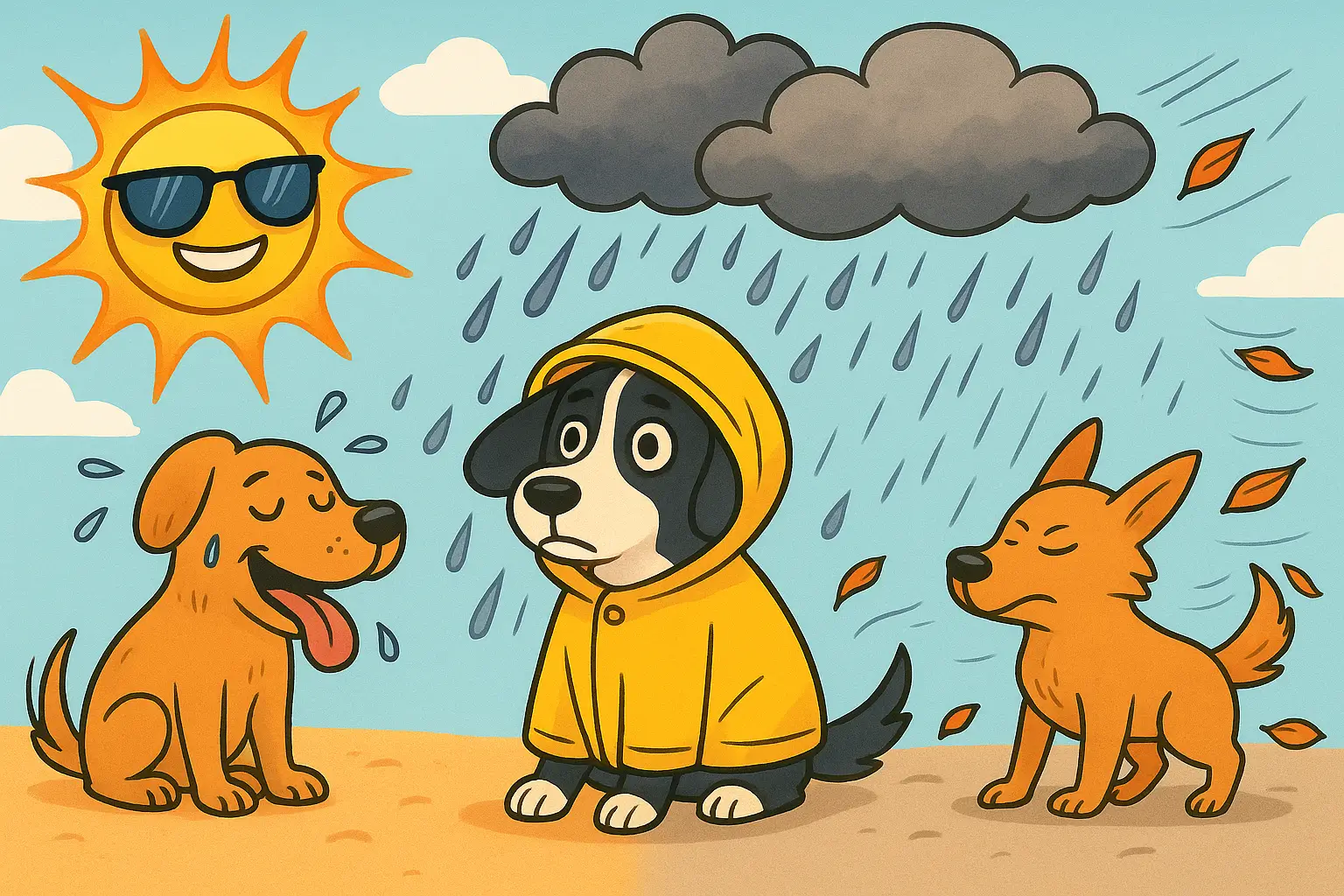
three cartoon dogs are shown. One sweltering under a hot sun. One getting blown by the wind. And one in a yellow raincoat stood under a raincloud. The picture is amusing.

 Dogs causing extreme weather?? Fact or Fur-Fueled Fiction?

Toggle Switch
Select Reading Level

Dog ownership’s role in extreme weather is vastly underestimated, new study finds

A recent Headline from Mainstram Media

Pinning extreme weather on our furry friends seems… well, extreme? But is it fair? Headlines like this one have recently popped up on a number of different news websites, so let’s put it through the Trailblazing Science Clickbait Checker

This article and many like it suggest a new study in the scientific journal PNAS Nexus had a rather surprising finding- that owning a dog causes extreme weather and people don’t realise it. But let’s not take their word for it- let’s go straight to the source itself and see what’s actually going on.

A corgi stands on his hind legs looking at the camera with a goofy expression. He gives the impression of being cute and innocent.

Huoadg5888Minor edits made by Subsidiary account, CC0, via Wikimedia Commons

Could this cute face really be to blame?

The Paper

The study behind the headlines is titled: Climate action literacy interventions increase commitments to more effective mitigation behaviors.”
A mouthful, yes but still no mention of dogs.

As we read the article, we discover that yes, dogs are briefly mentioned, but they are far from the focus or ‘key finding’ of the paper. So what did the paper really find out? 

What the Study Was Really About

The researchers wanted to know two things:

  1. Do people have an accurate sense of which personal actions have the biggest impact on fighting climate change?
  2. Can simple written information change people’s understanding  and their willingness to take those impactful actions?

To test this, they gave 3,895 people in the U.S. a list of 21 possible climate actions. These ranged from eating less beef, to flying less often, to recycling more and yes, also “not owning a dog.” They asked people which actions they were most likely to take. 

A lost of the 21 individual actions that were given to participants in the study. Examples include eating less meat and flying less often.
A lost of collective actions givent o participants in the study- things like voting for green policies.

The list of actions that researchers gave participants

Why Dogs Were Mentioned at All

Dog ownership was mentioned, as other studies have found that, yes, owning a dog does have an environmental impact. The production of dog food, as well as those doggy poops, do negatively affect the environment, and other studies have focused on what we can do to reduce this impact. But it was NOT the focus of this study. This study merely used dog ownership in its list of actions it presented to people.

What The Scientists DID do

Participants were divided into three groups:

  • Two groups received information (in different formats) about which actions really make the biggest impact.
  • A third “control” group received no extra information.

When asked again what actions they’d be most likely to take, both immediately and a week later, a clear pattern emerged:

  • People often underestimated the impact of high-value actions (like flying less, eating less beef, or yes, not owning a dog).
  • They overestimated the effect of lower-impact actions (like regular recycling).
  • Those given clear information were more likely to choose the actions with the biggest real impact.
A chart showing which activities people routinely underestimated the impact of and which they overestimated. The activities they underestimated the effectiveness of include taking one less long haul flight a year and not owning a dog. The actions they overestimated the effect of include efficient applances and recycling

Figure from “Climate action literacy interventions increase commitments to more effective mitigation behaviors,” PNAS Nexus, Vol. 4, Issue 6, 2023. DOI: 10.1093/pnasnexus/pgaf191.

An Unintended Twist

The study also uncovered something unexpected. When people learned more about individual climate actions, they became more likely to make those personal changes-but less likely to support collective actions, such as voting for green policies or joining climate demonstrations. The researchers hadn’t given the participants any information about these collective actions.

The authors cautioned that climate communication needs to balance both sides: empowering people to make effective personal choices without losing sight of collective action, which is equally crucial.

So Where Did the News Get It Wrong?

The alarming headlines weren’t completely false-it’s true that owning a dog has an environmental footprint, and climate change does drive extreme weather. But the way the story was framed was misleading.

By zooming in on dogs, the headlines oversimplified the issue and misrepresented the study. The research wasn’t really about pets at all. It was about how most of us don’t have a clear sense of which actions make the biggest difference for the climate and how providing clear information can shift our choices toward the most effective ones.

That’s not bad news. In fact, it’s the opposite: the study showed that when people are given the right knowledge, they are more likely to take high-impact actions. That’s hopeful, practical, and far more useful than blaming Fido for the next storm.

Why is the study important and why is it vital we get it right when talking about this. 

a lonely polar bear stands on a tiny patch of ice. He looks underweight. The scene is depressing.

Andreas Weith, CC BY-SA 4.0 https://creativecommons.org/licenses/by-sa/4.0, via Wikimedia Commons

Climate change is the greatest challenge facing humanity. Tackling it requires bold action from governments, businesses, and innovators worldwide. As the graph below shows, despite numerous climate agreements in the past 60 years atmospheric co2 and global temperatures have continued to rise.

A chart showing the increasing atmospheric co2 and rise in global temperature in the last 60 years. The milestones of various climate change agreements and policies are marked on the timeline showing that despite these both temperature and co2 levels are continuing to rise

CC BY 4.0 https://creativecommons.org/licenses/by/4.0, via Wikimedia Commons

In the face of this, we can often feel a little powerless- like our efforts are a drop in the ocean. After all, what impact can catching a train to the yearly family gathering rather than flying really have in the grand scheme of things??

 Yet studies suggest that individual behaviour changes could account for up to 40% of the emissions reductions needed by 2050. That makes personal action not a drop in the ocean, but a vital piece of the puzzle.

The catch is that not all actions are equal. If people misunderstand which changes make the biggest impact, they risk spending energy on less effective efforts. Since none of us can devote every moment to climate action, it’s essential we focus on the “high-impact moves” -the ones that matter most.

That’s the real value of this study: it shows that with simple, clear information, people are more likely to choose the most effective actions. In boiling this study down to ‘Dogs cause extreme weather’, we lose all the finesse of the study, do the science an injustice and ultimately miss the most crucial point. 

Verdict: Misleading clickbait that buries genuinely useful, hopeful news.

A test tube is shown to represent the 'clickbait concentration' of the article. Along the side is a scale ranging from low to 'full clickbait mode' A red liquid fills to between to 'moderate' and 'high' marks. Underneath is read 58!% indicating clickbait tactics were used but it's not the worst case Trailblaizing Science has seen.

 Spot the Clickbait: Sensationalism Red Flags

🔴 Red Flag 1: Headline Hijinks
Dogs were a tiny part of the study’s long list of 21 actions — but the headline made them the star.

🔴 Red Flag 2: Lost in Translation
The study was about how people misjudge climate actions, not about pets. Collapsing this into “dogs = extreme weather” skips the real nuance.

🔴 Red Flag 3: Fear Bait….Missing the Good News
The study actually found that when people get clear information, they change their behaviour for the better. That hopeful angle got buried.

A list of possible clickbait red flags is shown. Fear Bait, Headline Hijinks and Lost in Translation are coloured red, indicating that the paper is guilty of these tricks

Want to learn how to spot these “red flags” yourself? Download the free Trailblazing Science Clickbait Checker and don’t forget to sign up to the Trailblazing Science newsletter to receive REAL science you can trust straight to your inbox.

Related Posts

Leave a Reply

Your email address will not be published. Required fields are marked *