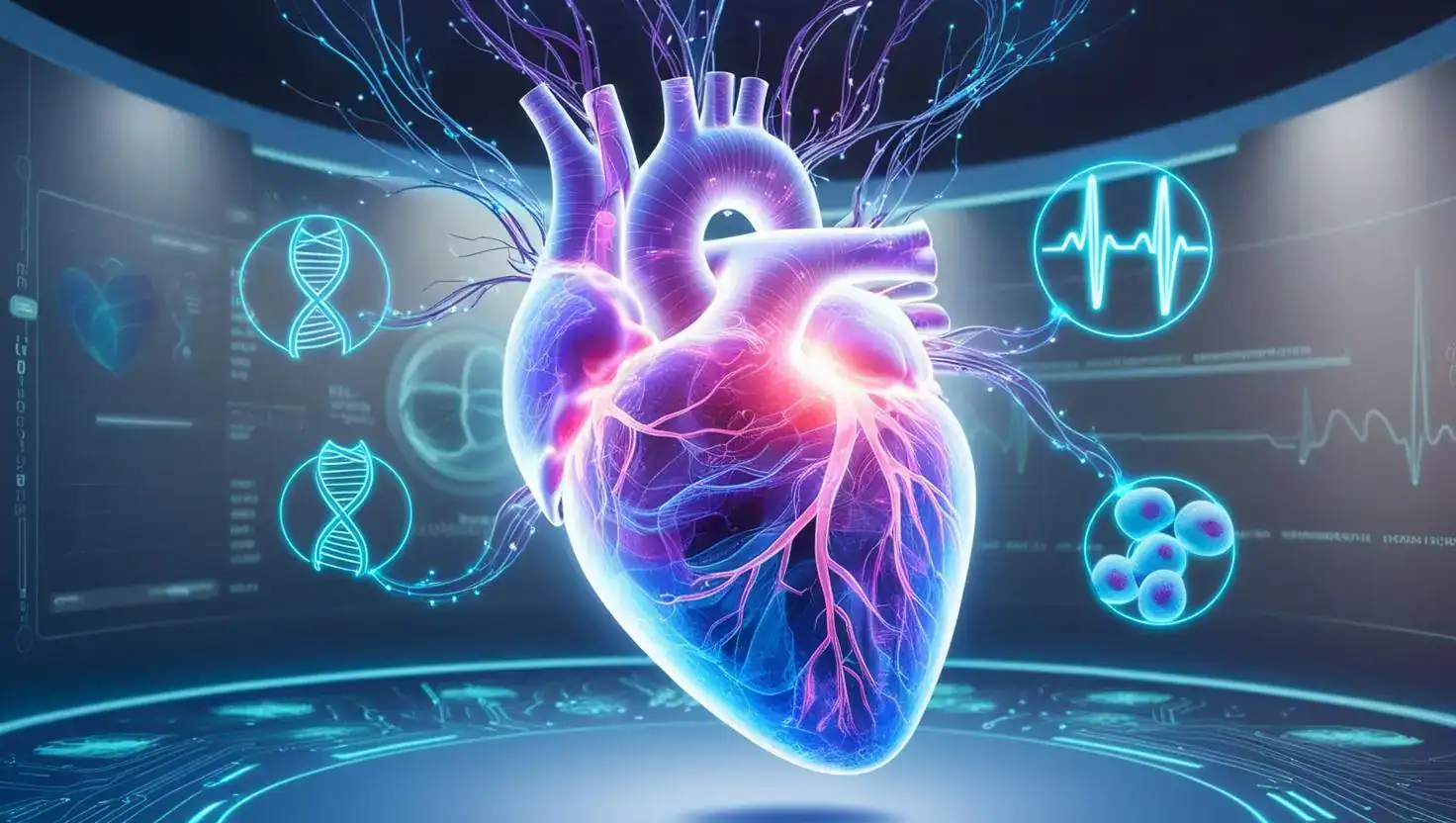
A glowing human heart appears suspended infront of holographic medical symbols like an ECG readout and a DNA structure. A futuristic image depicting the future of medicine.
|

10 Incredible Ways AI is Revolutionising Healthcare

Toggle Switch
Select Reading Level

In recent years, AI in healthcare has become a focal point of innovation, bringing unprecedented advancements to the medical field. From early disease detection to improving treatment precision, AI’s potential is transforming healthcare as we know it.

 One of the most significant benefits of AI is its ability to make complex medical processes faster, more accurate, and more accessible, even in the face of global shortages of medical professionals. 

Imagine an AI that helps radiologists quickly analyse medical images, potentially saving lives with split-second decisions. 

Or consider the development of AI-powered tools that can predict diseases like Alzheimer’s years in advance, giving patients and doctors a head start on treatment. 

The impact is profound, not just for patients in developed nations but also for underserved communities worldwide.

As we explore ten incredible ways AI is revolutionising healthcare, we will see how artificial intelligence improves patient outcomes and empowers healthcare professionals to deliver quicker, more personalised care. If you first want to get up to speed with the history of AI up to now, watch the video below.

Using AI to form a better picture of disease

Medical imaging techniques have evolved to give us an unprecedented insight into diseases. 

But here’s the problem—there simply aren’t enough radiologists to keep up. This global shortage means delays, missed diagnoses, and patients left waiting when time matters most.  This was only made worse after COVID-19, when many radiologists retired due to stress.

AI is changing the game in medical imaging, making it faster, sharper, and more insightful than ever before. 

A patient lies on their back about to enter an MRI machine. A male nurse stands next to them.

Photo by MART PRODUCTION

AI improves medical imaging by:

  • Enhancing contrast and reducing noise in images,
  • Identifying subtle abnormalities that may be missed by the human eye.
  •  Accelerating scan analysis, helping radiologists prioritize critical cases more efficiently. This allows them to focus their expertise where it matters most.

This leads to quicker, more accurate diagnoses, reduced stress for patients, and better treatment outcomes.

When time is of the essence 

A doctor points to a series of brain scans placed on a light board. There are many small images of the brain, each slightly different. Indicating the complexity of analysing the images.

Photo by Anna Shvets

A stroke can steal a life in minutes. It’s one of the leading killers, claiming 5.5 million lives each year. But the right treatment, delivered fast, can save lives and prevent devastating disability. Every second counts. 

AI can help:

  • It can analyse MRI and CT scans instantly and making split-second decisions that could save a life.
  • It can also quickly differente between types of strokes, ensuring the patient gets the correct treatment for them. Delays or incorrect stroke treatment can mean the difference between recovery and lifelong disability. 
  • Some AI tools even have automated systems to alert the appropriate specialists, again shaving valuable minutes off the response time. 
  • AI can also analyse a patient’s medical imaging and history to predict how they will respond to the various treatment options, allowing complex decisions to be made quickly in a time-pressured situation. 

Protecting Patients: Reducing Radiation Risks

Photo by Cottonbro Studios

Medical imaging saves lives and generally uses very low levels of radiation. However, for some vulnerable patients, especially children and cancer patients, repeated radiation exposure can be a concern. 

Doctors face a constant balancing act: using enough radiation for a clear image while minimising long-term risks. 

AI is now making that decision easier, refining images so doctors can use lower doses without losing quality.

 Not only this, but AI can also tailor radiation doses to each individual, making sure just enough radiation is used but never unnecessary excess. This individual approach is a real game-changer. Some studies report that AI has the potential to reduce the dose by 95% while retaining crystal-clear image quality, an extraordinary breakthrough that could protect children, cancer patients, and other vulnerable individuals from unnecessary risk4

A female doctor holds x-ray image of a human skull up towards the camera. She is looking through it to the camera.

Stopping Alzheimer’s in its Tracks: The Power of Early Detection

When it comes to disease, early detection isn’t just helpful, it’s life-changing. The sooner we act, the better our chances of fighting back. But for diseases like Alzheimer’s, where symptoms creep in slowly and diagnosis often comes too late, this is easier said than done. That’s why AI’s ability to spot early warning signs, sometimes years in advance, could be a game-changer. 

To halt the march of Alzheimer’s disease, it must be diagnosed early, before clear symptoms are present. Early diagnosis means patients can access treatments and lifestyle changes that could delay symptoms by years.

 Conventional diagnostic methods often identify brain damage only after it has become irreversible, limiting opportunities for early intervention. 

FMRI is a new imaging technique which has shown promise in detecting early-stage Alzheimer’s disease. Unlike traditional MRI, which gives static images, fMRI (The f stands for functional) shows real-time brain activity in response to various tasks. Doctors can use this to see how the brain of a suspected Alzheimer’s patient is functioning compared to a healthy brain. 

The problem is that fMRIs provide data that is complicated and often very difficult to interpret. But scientists have now combined fMRI imaging with deep machine learning to develop a system that can detect early-stage Alzheimer’s with 85% accuracy in early tests. Now comes the work to see if we can replicate this success in the complex real world. 

But that’s not all. Incredibly, scientists in California have developed an AI which can use electronic health data to accurately predict Alzheimer’s disease up to 7 years before diagnosis

These AI advancements mark significant progress toward universal early-stage Alzheimer’s detection. While clinical adoption is still evolving, researchers estimate that in the next decade, AI-driven diagnostics could become commonplace: transforming the way we detect and treat diseases,

One size does not fit all. 

No two people experience disease the same way. 

You and I could have the same diagnosis but completely different symptoms, different treatment responses, and even different side effects. 

That’s the challenge doctors face. But AI is helping to unravel these mysteries, using vast amounts of data to personalise treatments like never before.

With the advent of improved genetic sequencing technologies, we can now access an unprecedented amount of information about ourselves and our disease profiles. But what can we do with this incredibly complex data, and how can we use this to make better medical decisions? The sheer volume of data is mind-blowing. 

A woman stands facing the camera. Large amounts of data in the form of numbers are letters are projected onto her and the wall behind her. It gives both a futuristic feel and a feeling of an overwhelming amount of information.

Photo by This Is Engineering

AI bridges this gap by processing vast amounts of genetic and clinical data. One interesting development has been led by scientists in Chicago. They have used vast databases of clinical data to gain a comprehensive understanding of the inner workings of cancer. They have used AI algorithms on this data set to detect patterns that are usually invisible to human researchers.

They are now applying AI learning to provide faster and more accurate diagnosis and treatment planning. They can take genetic data from a cancer patient and identify specific ‘flags’ at the molecular level. These provide signals to the AI, which can use its learning to predict which treatments will most likely be effective and provide personalised treatment recommendations. Unnecessary treatments are prevented, and the patient receives care which can prove either lifesaving or a gift of valuable extra time.

Finding new medicines faster. 

A pile of pills in different shapes and sizes fills the screen.

Image by Mirjiam Zillis on Unsplash

The process of finding a new drug is a long, expensive road filled with many roadblocks. Sadly, many of these roads abruptly stop at dead ends. The journey has to begin again. 

AI is helping to streamline this process, discovering new medicines faster and with less trial and error. We are living in a world with unprecedented access to huge databases full of information about the makeup of human disease and the chemical tools that could be used to attack them. There are now many companies worldwide turning the attention of machine learning to this opportunity for progress. 

One exciting company doing just that is Antiverse, based in Cardiff, Wales. To discover a new drug, scientists search for novel antibodies to stick to disease-causing units or ‘antigens’. Like a lock and key, antibodies must precisely match antigens to be effective. When they hit their target, they can neutralise the disease-causing units, helping to fight the disease. 

A doctor holds out two tablets, one in each hand as if giving a choice. It represents the selection of the right medicine for the exact problem.

Photo by Karolina Grabowska

Now, imagine that finding the right antibody/antigen pair is a bit like dating on a dating app. Finding the right partner can take a long time and involve a lot of trial and error. There are many bad dates along the way! But Antiverse’s AI is like a super matchmaker that has analysed millions of previous dates, and instead of setting up random blind dates, it can accurately predict which antibodies “click” with an antigen. This way, instead of spending years testing antibodies in the lab one by one, AI can quickly narrow down the best candidates, making the whole drug discovery process faster, cheaper, and more precise. Leading to more affordable treatments that reach patients sooner.

Of course, discovering a new drug is just the beginning. The next challenge is delivering it safely and exactly where it’s needed. Make sure you check out our blog to see how scientists are using tiny microrobots to deliver medicine right to the Achilles’ heel of lung diseases.

Fighting back against antibiotic resistance 

Antibiotic resistance is a pressing problem in modern society and has emerged from a perfect storm. Bacteria evolve very fast, which means overuse and misuse of antibiotics have led to many bacteria evolving and learning how to evade our existing antibiotics. In contrast to the fast evolution of bacteria, the discovery of new antibiotics is very slow. It takes many years and a huge investment of funds. As such, the discovery of new antibiotics has all but dried up. Until recently. 

A collection of various pills and capsules are arranged into a question mark. It represents the quest to find which chemical compound could be the next big antibiotic

Photo by Anna Shvets

Scientists at MIT used AI to screen over a hundred million chemical compounds and search for potential new antibiotics. In just days, they found a potent new compound called Halicin. In lab tests, halicin effectively killed many of the world’s most problematic disease-causing bacteria, including some strains resistant to all known antibiotics. Halicin still needs to go through clinical trials before it can be used, but its promise demonstrates just how quick and comparatively easy the future of drug discovery could be using AI.

AI as your pocket doctor 

What if you never had to wait for a doctor’s appointment again? What if your health was monitored in real-time, catching problems before they even started? AI is making this a reality, bringing medical support into your home like never before. 

Mental health monitoring and assessment 

A face is half covered in dark shadow. The expression is somber giving a dark heavy feeling to the photo. It represents depression and bad mental health

Photo by Phael

The dawn of AI as a virtual health assistant reached a huge milestone last year when the FDA granted authorization for the initial testing of an AI-driven mental health assessment tool known as the AI-Generated Clinical Outcome Assessment (AI-COA). Traditionally, monitoring of mental health disorders like depression and anxiety relied on self-reported questionnaires and patient interviews. These methods are subjective and often not timely enough to be most effective. AI-COA offers real-time monitoring of physiological factors like eye movements, voice patterns, vital signs and facial expressions. These combine with machine learning to provide real-time objective measurements. Real-time assessments mean earlier interventions, reducing the severity of conditions like depression and anxiety.

On-demand physio 

If you have experienced persistent back pain, you’ll know how it affects every part of your daily life and can grind even the most persistent optimist down. You’ll also know how long you have to wait for a physio appointment in many locations around the world. Globally, demand massively outstrips the availability of physiotherapists. One solution is currently being trialled in Scotland. “Kirsty” is an AI-powered physiotherapist designed to address back pain and reduce NHS waiting times. 

A woman sit on a massage table with her head cocked to one side while a physiotherapist kneels behind her and places her hand on the patients sides.

Photo by Yan Krukow

Kirsty:

  • allows people to book same-day appointments 
  • provides exercise routines and pain management. 
  • Refers back pain sufferers to qualified physiotherapists if further assistance is needed. 

This novel approach could not only offer immediate relief for back pain sufferers but also free up face-to-face appointments for those who need them most. 9

Wearables and AI for at-home monitoring

Gone are the days of fitness trackers just tracking your steps; now, wearable devices like Apple’s smart watch are providing valuable medical data. Researchers have used AI to modify a normal ECG, which normally requires 12 leads to be placed around a patient’s body, to be able to work from a single contact point on the smart watch. This allows for completely unobtrusive, detailed reading on the go. 

A smartphone lies next to a stethoscope, symbolizing how mobile technology is beginning to replace traditional heart checkups

Photo by Negative Space

Researchers recently found that such a set-up could accurately detect a weak heart pump. This normally requires extensive and expensive testing at the hospital. Diagnosis is important to be able to offer interventions which can improve quality of life and prevent future heart failure. 10

Helping communities around the world

AI also has the potential to plug the gaps for communities which have less access to medical facilities. One shining example of this is Google’s AI for diabetic retinopathy (DR). DR is a leading cause of blindness worldwide. Early treatment can prevent blindness in 90% of cases. Unfortunately, not everyone can access this crucial intervention, particularly in developing countries. 

An elderly indian woman looks out of a window. The discolouration of her eyes suggests she is blind or partially sighted. She has a peaceful but resigned look on her face.

Photo by Resizedjan Canty on Unsplash

Google has developed an AI system that:

  • Can detect diabetic retinopathy from retinal images as well as any professional can. 
  • Does not require an eye specialist to interpret the results 
  • Works in seconds. 

This initiative is already being implemented in Thailand and India, not only preventing blindness but also sparing entire families from the hardships that come with vision loss.

Fighting global health inequality is really important. Next, read our blog about how doctors use 5G technology to perform surgeries from far away on stomach cancer patients in remote places

The challenges ahead

While AI brings immense promise, serious challenges remain:

  • Data Security and Privacy: Healthcare AI relies on massive amounts of sensitive data. Safeguarding this information is crucial.
  • Bias in AI Systems: AI is only as good as the data it is trained on. If the data sets themselves have racial or gender-based biases, as they often do, they will not be able to help everyone equally.
  • Accessibility: Developing and installing AI systems is expensive, potentially widening the gap between rich and poor hospitals.
  • Human-AI Collaboration: AI should support, not replace doctors. Tools must be intuitive and easy to integrate into existing workflows.
  • Medical Liability: If AI makes a mistake, who is responsible? The doctor? The hospital? The company that built the AI? These legal and ethical questions need to be solved before AI can be fully trusted in life-or-death situations.

These issues will certainly need much thought and collaboration to reach solutions in the future. However it cannot be denied that the future of healthcare certainly features much use of AI. The promise is simply too great to ignore. 

A young boy in a doctors coat stand in front of a stream of data falling in light streams from the sky. The feeling is one of hope for the future.

Photo by Ron Lach

In this article, we’ve uncovered some of the most pivotal ways AI is revolutionising healthcare, from transforming medical imaging and stroke diagnosis to combating antibiotic resistance and enabling early Alzheimer’s detection. We’ve also explored how AI is making treatments more personalized, reducing radiation risks, and even helping communities with limited access to medical resources. The potential for AI to save lives, reduce costs, and improve the efficiency of healthcare systems is undeniable. But this potential is not without its challenges. There will definitely be bumps along the road. And there is still a lot yet to be defined. 

As we move forward, it’s clear that AI will continue to shape the future of medicine, offering new opportunities for earlier detection, more accurate diagnoses, and tailored treatments. But we want to hear from you—what excites you most about AI in healthcare? Leave your thoughts and comments below, and let’s keep the conversation going.

If you want to stay up-to-date with the latest trends and breakthroughs in AI and healthcare, don’t forget to sign up for our newsletter. Together, we can explore how AI is paving the way for a healthier future for all.

Here’s some ideas to spark a fascinating discussion.

  • How do you think AI will shape the future of healthcare in the next 10 years?
  • Can AI-driven virtual assistants replace some healthcare professionals, and what are the implications?
  • How much would you trust a robot or computer to make decisions about your health, and why?
  • If you could create one rule about how AI should be used in medicine, what would it be?

Big Family Question:

If you could design your own health robot or app, what would it do to help you and your family?

Looking for more family-friendly discussion prompts? Explore our child-focused version of this blog here.

Curious but cautious?

Love diving into science, but not always sure what to believe? Grab our free guide:
“5 Ways to Spot Fake Science News”
It’s full of quick, practical tips to help you tell real breakthroughs from misleading headlines.

AI is transforming the future of healthcare, from diagnostics to personalised treatments. Subscribe to our newsletter and stay informed on the innovations reshaping medicine.

Keep Exploring

Curious about the future of medicine? Dive into these fascinating stories next:

Robot Surgeons in Action — Witness how cutting-edge technology allows doctors to perform surgeries from miles away.

Microrobots in the Lungs — Explore how tiny, smart machines are revolutionizing treatment by targeting diseases from within.

Let’s Talk About It

Do you think there’s a limit to how much we should let AI make decisions about our health or are we just getting started? We would love to hear your thoughts- let us know below:

Related Posts

Leave a Reply

Your email address will not be published. Required fields are marked *